باختصار
- In 2025 RAK residential turned over AED 12.4bn across about 6,600 deals, with off-plan at 85% of activity. Transaction value fell about 24% year on year on fewer launches, even as prices kept rising, per Cavendish Maxwell.
- Prices ran ahead of the legacy forecast: apartment values rose about 13.4% and villas about 9.7% over 2025, with Al Marjan at about AED 1,328 per sqft and Yasmin Village leading rental ROI near 12.2%, per Bayut.
- The Wynn Al Marjan Island resort, the central catalyst, has been revised up to about USD 5.1bn and its opening, once targeted for early 2027, faces a delay from the 2026 Iran war, with completion now read toward late 2027.
- For 2026, consultants forecast prime waterfront apartments up about 15-20% and off-plan sales up a similar margin, with the Wynn delay and regional geopolitics the key downside risks to tourism-led demand.
المحتويات
- 01The economic and policy landscape behind RAK.
- 02Wealth migration and investor inflows.
- 03Residential property prices in 2026.
- 04Off-plan and branded residences.
- 05The Wynn catalyst, recosted and delayed.
- 06The commercial market: a qualitative read.
- 07Infrastructure and urban development.
- 08Risks and challenges to weigh.
- 09The outlook for RAK property in 2026.
- 10Omnia investment recommendations.
- 11Looking forward across the wider UAE.
Ras Al Khaimah, the northernmost emirate of the UAE, enters 2026 as the country’s hottest emerging property market, but with a more nuanced signature than the headlines suggest. RAK’s property market set a record in 2024, when transaction values rose 118% to AED 15.08 billion. In 2025 the picture turned: residential sales value eased about 24% to AED 12.4 billion across roughly 6,600 deals on fewer launches, even as prices kept rising, with apartment values up about 13.4% and villas up about 9.7%, per Cavendish Maxwell. This is a market where activity has cooled from its peak while values have not.
That matters because earlier readings of RAK leaned on a forward forecast of modest single-digit growth that the actuals overshot, and on a USD 3.9 billion Wynn resort opening in 2027 that is now both costlier and later. What follows sets out where prices, yields, supply and the Wynn catalyst really stand in 2026, drawing on Cavendish Maxwell, Bayut, CBRE, Colliers, S&P and Henley & Partners, with an honest read of the downside risks.
Source: Ras Al Khaimah Municipality (2024) and Cavendish Maxwell (2025). 2024 set a record; 2025 value eased on fewer launches even as prices rose. Indicative; not investment advice.
The economic and policy landscape behind RAK.
Economic growth in Ras Al Khaimah. RAK’s roughly USD 13 billion economy is expanding and diversifying. S&P estimates the emirate grew about 4.3% in 2025 and projects growth near 3.3% across 2025 to 2026, accelerating to about 4.3% in 2027 to 2028 on strong tourism and real estate, with the sovereign rating reaffirmed at A with a stable outlook. No single sector accounts for more than about 27% of GDP, a deliberate spread across tourism, manufacturing and services. In 2024 the Ras Al Khaimah Economic Zone (RAKEZ) welcomed 13,141 new companies, a 66% increase on 2023, taking its base to about 30,000 firms and feeding demand for commercial and residential space. The emirate sits within a four-hour flight of roughly a third of the world’s population.
Policy reforms driving real estate. RAK’s government has put in place investor-friendly policies to sustain real estate growth.
- Freehold ownership. Foreign investors can own property outright in designated zones such as Al Marjan Island, Al Hamra Village and Mina Al Arab.
- Tax advantages. No personal income tax, capital gains tax or property transfer taxes keep RAK a low-cost destination for individual investors.
- Business-friendly environment. Zero corporate tax for free-zone entities and streamlined licensing through RAKEZ attract global businesses.
- Visa incentives. Long-term residency visas tied to property investment encourage relocations.
Tourism and population growth. Tourism is the key driver of real estate demand. RAK is targeting 3.5 million annual visitors by 2030, nearly triple the 1.28 million recorded in 2024, and is roughly doubling its hotel inventory of about 8,500 keys. The Wynn Al Marjan Island resort, covered in detail below, is the central catalyst. The emirate’s population is projected to grow from about 400,000 toward 650,000 by 2030, which on official estimates requires around 45,000 new homes and underpins long-run housing demand.
Wealth migration and investor inflows.
Wealth migration into the UAE. RAK’s pull cannot be read apart from the wider UAE story. The UAE remained the world’s number-one destination for migrating wealth in 2025, with a record net inflow of about 9,800 millionaires, following about 6,700 in 2024, per the Henley Private Wealth Migration Report. RAK’s appeal within that flow is its relative affordability against Dubai and Abu Dhabi: more accessible beachfront entry points, paired with the same zero personal-tax framework, draw both regional and international buyers, though precise per-emirate inflows are not separately published.
Where the capital is going. Three segments are pulling the most demand.
- Branded and waterfront residences. Buyers favour branded and waterfront stock on Al Marjan Island and in Mina Al Arab. Of the roughly 14,000 residential units in the 2026 to 2029 pipeline, about 5,604 (close to 40%) are branded, per Colliers and Savills.
- Off-plan. Off-plan is now the dominant mode of buying, accounting for about 85% of RAK residential deals in 2025, on lower entry prices and staged payment plans, per Cavendish Maxwell.
- Income stock. Cheaper, established communities such as Yasmin Village still attract yield-led buyers, leading RAK on rental ROI near 12.2%, per Bayut.
Why RAK, specifically. The case rests on three points: more affordable waterfront than Dubai for comparable product, rental returns that remain competitive in the cheaper segments, and a lifestyle mix of beaches, mountains and heritage with modern amenities. The affordability point is qualitative here by design: the precise entry-price comparisons quoted in older readings did not stand up to checking.
Residential property prices in 2026.
What actually happened in 2025. The genuine 2025 story is prices up, activity down from the 2024 peak.
- Transaction value. Residential sales reached about AED 12.4 billion across roughly 6,600 deals, down about 24% on 2024 as fewer projects launched, per Cavendish Maxwell.
- Price growth. Average apartment prices rose about 13.4% and villas about 9.7% over the year, per Cavendish Maxwell, with Bayut’s advertised asking prices up as much as 30.4% for apartments and 41.9% for villas.
- Off-plan dominance. Off-plan made up about 85% of deals, the clearest sign that buyers are positioning ahead of the Wynn-era supply, per Cavendish Maxwell.
Q1 2025 was the inflection. CBRE recorded residential prices up about 39% year on year in the first quarter of 2025, with apartments around AED 1,684 per square foot and villas around AED 1,145 per square foot, on roughly 1,300 off-plan deals worth about AED 2.4 billion. The surge was driven by branded launches on Al Marjan Island and in RAK Central.
Source: Cavendish Maxwell (transacted prices) and Bayut (advertised asking prices), 2025. Indicative; not investment advice.
The area read. RAK prices are quoted per square foot, and Bayut’s 2025 benchmarks show a clear spread from the prime coast to the value interior.
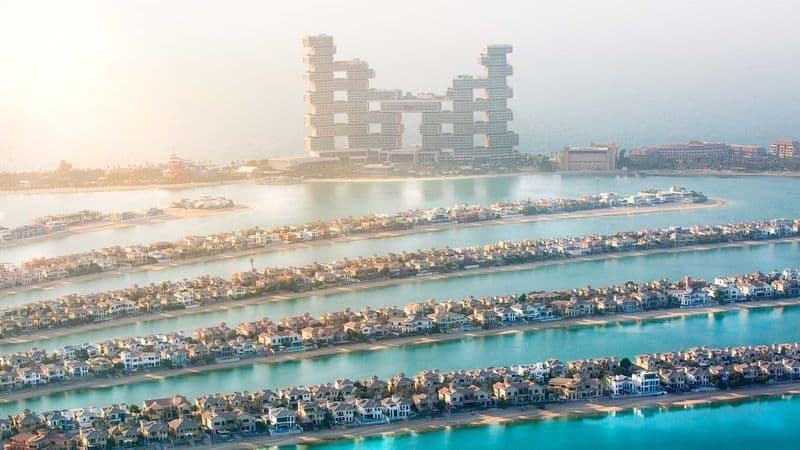
- Al Marjan Island. The prime waterfront and Wynn frontage, averaging about AED 1,328 per square foot, up about 21.3% over 2025, per Bayut.
- Mina Al Arab. A high-end coastal community, averaging about AED 1,344 per square foot, per Bayut.
- Al Hamra Village. An established golf-and-marina address, averaging about AED 1,027 per square foot, up about 30.4% over 2025, per Bayut.
- Yasmin Village. The value entry point, averaging about AED 285 per square foot and leading RAK on rental ROI near 12.2%, per Bayut.
Rental yields, read honestly. Because capital values ran ahead of rents, prime coastal yields have compressed: Bayut’s 2025 figures put Al Marjan near 5.5%, Al Hamra near 5.8% and Mina Al Arab near 5.0%, with the blended market in the mid-single digits. Only cheaper, older stock such as Yasmin Village still pays double digits, near 12.2%. The blanket high-single-digit average quoted in older readings overstated prime returns.
Supply pipeline. Roughly 1,200 homes were delivered in 2025, with about 1,300 due in 2026, about 1,900 in 2027 and a sharp step up to about 5,200 in 2028, for around 8,400 units over three years, per Cavendish Maxwell. More than 30,000 units have launched since 2022, about 30% of them branded, and most 2022 to 2024 projects sold 80% to 90% within 12 to 18 months. Supply is building but still trails the demand the Wynn era is expected to bring.
For 2026, consultants forecast prime waterfront apartments up about 15-20% and off-plan sales up a similar margin, with the more bullish houses citing as much as 50% by the casino opening. The honest read sits with the consultants, not the countdown.
Off-plan and branded residences.
Off-plan leads the market. Off-plan accounted for about 85% of 2025 deals and is forecast to rise a further 15% to 20% in 2026 as branded launches continue, per Cavendish Maxwell and Gulf Business. The appeal is staged payments and a lower entry against ready stock, with the trade-off being construction and delivery risk.
Branded supply. About 40% of the 14,000-unit 2026 to 2029 pipeline is branded, roughly 5,604 units, per Colliers and Savills. Live Al Marjan Island projects include the JW Marriott Residences by WOW Resorts, with handover read toward 2028, Address Residences Al Marjan Island by Emaar, targeted for around the fourth quarter of 2028, Nikki Beach Residences by Aldar with Nikki Beach, completing around the fourth quarter of 2028, and Manta Bay by Major Development. Branded residences typically transact at a premium to comparable non-branded stock, which supports demand at the top of the market.
The Wynn catalyst, recosted and delayed.
A bigger budget. Wynn Al Marjan Island is the demand engine for the whole emirate, and both of its headline facts have moved. The integrated resort’s budget has been revised up to about USD 5.1 billion, from the USD 3.9 billion figure that older readings quoted. As of early 2026 Wynn Resorts had spent or committed about USD 3.4 billion, roughly two-thirds of the total, with its equity contribution past USD 1 billion and more than 22,000 workers on site. The tower topped out in December 2025.
A later opening. The opening, once targeted for the first quarter or spring of 2027, faces what CEO Craig Billings described in May 2026 as a "modest delay". The trigger was the 2026 Iran war: the conflict, which broke out in late February 2026, briefly paused construction before work resumed in March, and Strait of Hormuz logistics disruption slowed the flow of materials. A realistic completion now reads toward late 2027 rather than early 2027.
What it changes for buyers. The resort still anchors the long-run case, the first regulated gaming destination in the region, set to draw millions of visitors a year and to support short-let and hospitality demand around Al Marjan Island. But the recosting and the slip matter for timing. Underwriting that assumes a hard early-2027 opening, or the most bullish "50% by the casino" price calls, now carries more delivery and sentiment risk than it did a year ago.
The commercial market: a qualitative read.
RAK’s commercial market is real but thinly documented. There is no credible independent series for RAK office or retail price growth, yields or rents at the granularity older readings implied, and the precise figures they carried do not hold up. Qualitatively, the direction is supportive: the influx of 13,141 new companies into RAKEZ in 2024, taking its base near 30,000 firms, and the build-out of RAK Central and tourism-led retail around Al Marjan Island keep office and retail demand firm. The honest position is occupancy and demand strength rather than headline price points. Investors needing precise commercial numbers should commission a project-level appraisal rather than rely on a market average.
Infrastructure and urban development.
Mega-projects driving growth. RAK’s infrastructure investment is reshaping its real estate landscape.
- Wynn Al Marjan Island. The roughly USD 5.1 billion integrated resort, the central catalyst, with opening now read toward late 2027 after a delay tied to the 2026 Iran war.
- Al Marjan and Mina Al Arab build-out. Branded and waterfront launches continue across the prime islands, adding both supply and amenity.
- RAK International Airport. Expanded routes and capacity to support a 3.5 million visitor target by 2030.
- Road and highway upgrades. Improved connectivity to Dubai, about an hour away, sustains RAK’s appeal for commuters and businesses.
Sustainability. RAK developers increasingly market energy-efficient design, with communities such as Mina Al Arab and Al Marjan Island leaning into it. The point is qualitative: the specific green-certification share quoted in older readings could not be verified and has been removed rather than repeated.
Connectivity and logistics. RAK’s position about an hour from Dubai, its ports including Al Hamra Marina, and its highway network support both logistics and residential growth across the emirate.
Risks and challenges to weigh.
Geopolitics and the Wynn delay. The clearest near-term risk is geopolitical. The 2026 Iran war and associated Strait of Hormuz logistics disruption paused Wynn construction in late February 2026 and have already pushed the opening later. Because so much of RAK’s premium-pricing case is tied to the Wynn-driven tourism story, any further slip or escalation would weigh directly on demand and sentiment.
Activity cooling from the peak. Transaction value fell about 24% in 2025 on fewer launches, even as prices rose. A market where value contracts while prices climb is one to read carefully: it can reflect supply timing rather than weakening demand, but it also means the headline growth numbers rest on a thinner base of deals.
Forecast dispersion. There is a real gap between what consultants model, prime waterfront up about 15-20% in 2026, and the most bullish broker calls of up to 50% by the casino opening. Buyers should anchor to the consultant range and treat the higher numbers as marketing, not a base case.
Yield compression and supply. Prime coastal yields have compressed to about 5-6% as capital values outran rents, so income-led buyers face lower returns outside the cheaper segments. With about 8,400 units due over 2026 to 2028, a heavy 2028 delivery year could test absorption if demand does not keep pace. Diversifying across communities and asset types remains the clearest mitigation.
The outlook for RAK property in 2026.
Where the market really stands. Read against the sources, RAK in 2026 is positive but measured.
- Prices. After rising about 13.4% for apartments and 9.7% for villas in 2025, consultants forecast prime waterfront apartments up about 15-20% in 2026, with the rest of the market more modest.
- Activity. Off-plan, about 85% of 2025 deals, is forecast up a further 15-20% in 2026, while total value depends on the launch calendar.
- Supply. About 1,300 homes are due in 2026 and roughly 8,400 over three years, easing some constraints ahead of a heavy 2028 year.
- Catalyst. The Wynn resort, now about USD 5.1 billion and opening toward late 2027, remains the long-run anchor, with its delay the key risk to time.
Source: CBRE (Q1 2025), Cavendish Maxwell (FY2025 actuals) and consultant forecasts (2026, upper end of the prime-waterfront range). Indicative; not investment advice.
Omnia investment recommendations.
Four plays stand out across the RAK market for 2026.
- Masterplan-backed off-plan. Branded and waterfront off-plan on Al Marjan Island, such as the Address, JW Marriott and Nikki Beach residences, captures the Wynn-era pipeline at staged entry, while accepting delivery risk.
- Income at the value end. For yield rather than capital growth, established communities like Yasmin Village still pay double-digit ROI where prime coastal stock has compressed to about 5-6%.
- Buy the consultant range, not the countdown. Underwrite to the about 15-20% prime-waterfront forecast and the late-2027 Wynn read, not to the most bullish casino-opening price calls.
- Diversify against the risks. Spread across communities and asset types to soften the geopolitical, delivery and absorption risks that a single Wynn-linked bet would concentrate.
Looking forward across the wider UAE.
Ras Al Khaimah’s property market in 2026 is a market where prices kept climbing as activity cooled from the 2024 record. With apartment values up about 13.4% in 2025, off-plan dominant, and the roughly USD 5.1 billion Wynn resort still anchoring the long-run case despite a delay, RAK rewards selective buyers who weight the actual numbers over the marketing. Al Marjan Island, Mina Al Arab and Al Hamra Village lead the prime tier, while cheaper communities carry the yield. Omnia recommends a diversified strategy that respects both the upside and the geopolitical and delivery risks now in plain view.
RAK’s trajectory reads as part of the wider story across the United Arab Emirates, where capital keeps moving north from Dubai and Abu Dhabi in search of affordability, yield and headroom for growth, and where the country has stayed the world’s number-one magnet for migrating wealth. For investors building UAE exposure, the northernmost emirate remains one of the clearest expressions of that shift. Every figure here is indicative and not investment advice.
استشارة
تحدّث إلينا على انفراد.
مستشار من أومنيا حول التوافر والهيكلة والتوقيت في هذه الأسواق.
 متاحبركاءحي النسيمالنوعمساكناستكشف الإقامة