باختصار
- Over 2014-2024 Montenegro recorded a 124% rise in resident millionaires, the highest of any country, ahead of Monaco, Singapore and Switzerland, on a still-modest base of about 2,800 millionaire residents (Henley 2025).
- A nation of about 625,000 has drawn more than €1bn in real estate and citizenship inflows and buyers from over 40 nationalities, with US demand now the fastest-growing segment under the Work-from-Europe trend.
- Montenegro has used the euro since 2002 and became an operational SEPA member on 6 October 2025, cutting the average euro transfer cost from about €73 to about €6.
- It is the EU enlargement frontrunner: 16 of 33 chapters provisionally closed by June 2026, with negotiations targeted to conclude by end-2026 and membership by 2028.
المحتويات
- 01A wealth migration story on the Adriatic.
- 02Who is buying Montenegro property, and where.
- 03The standout developments adding long-term value.
- 04A broader economic transformation underneath the coast.
- 05SEPA entry has eased euro transfers for buyers.
- 06Montenegro’s path to EU membership by 2028.
- 07The legacy of the citizenship programme.
- 08Global millionaire migration and Montenegro’s opening.
- 09Remote working and the year-round resident.
- 10What investors should weigh before committing.
- 11Montenegro’s long-term outlook into 2026.
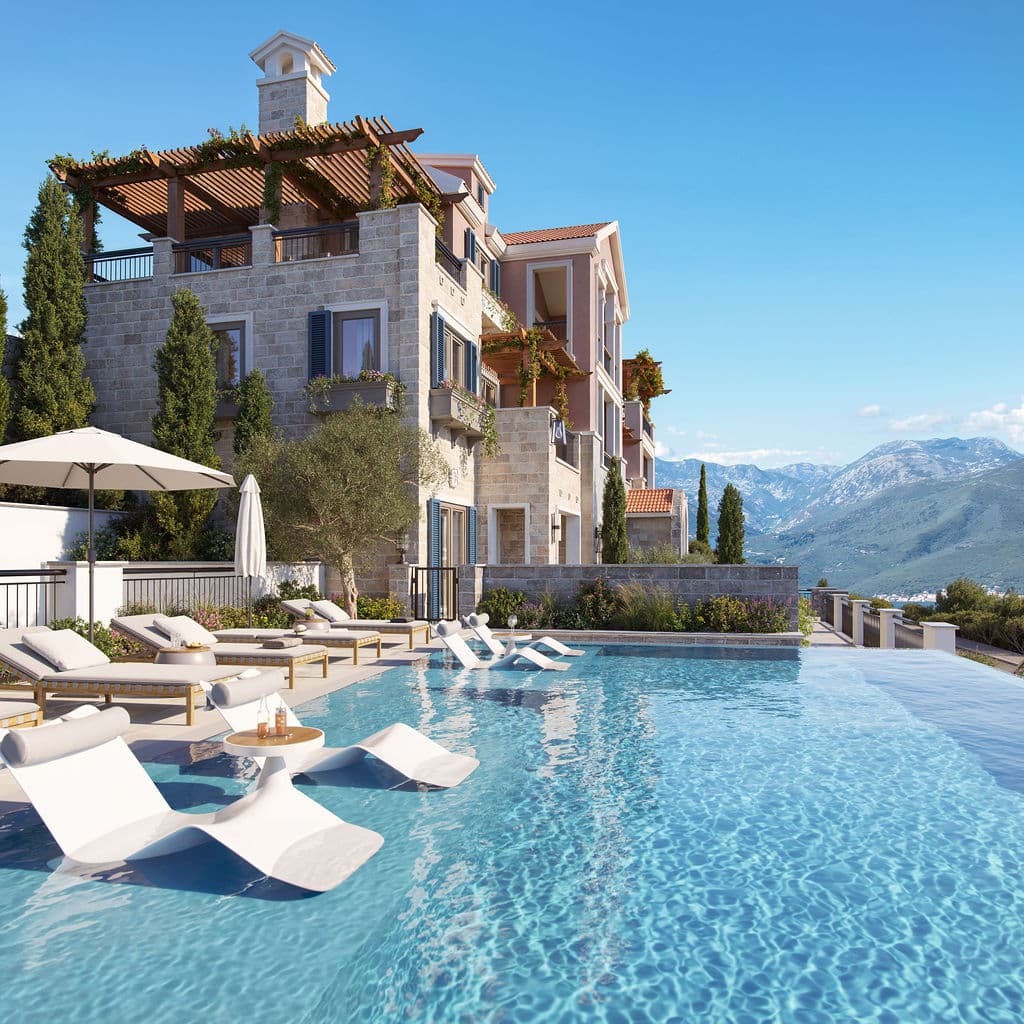
Montenegro has matured from a little-known Balkan market into an established Mediterranean wealth-migration and property hub. The fastest growth in resident millionaires anywhere over the past decade is no longer a surprise but a well-circulated headline, and by 2026 this Adriatic nation of about 625,000 people is on the shortlist for globally mobile capital, with its coast trading at historic highs.
This report takes the macro view: the wealth-migration story, the capital flows and the structural catalysts behind the market, rather than a project-by-project tour. For the standout developments, the full cost of a purchase and where the highest-value addresses sit, we cross-link to three companion Montenegro reports rather than repeat the detail here.
A wealth migration story on the Adriatic.
Over 2014 to 2024, Montenegro recorded the highest growth in resident millionaires of any country in the world. Henley & Partners’ 2025 Private Wealth Migration Report put the rise at 124%, ahead of established hubs such as Monaco, Singapore and Switzerland. The absolute base is still modest, around 2,800 resident millionaires by December 2024 alongside a handful of centi-millionaires and billionaires, but the trend marks a profound shift, and by 2026 it is a settled part of the market’s story rather than a fresh discovery.
Montenegro is no longer simply receiving visitors. It is gaining permanent residents with significant capital to deploy. That wealth, increasingly concentrated in the coastal real estate market, is reshaping both local economies and regional development strategy. Total capital inflows through citizenship programmes and real estate development have passed €1 billion, with the coast, and in particular Porto Montenegro, Budva and Kotor, drawing the bulk of it.
Who is buying Montenegro property, and where.
Montenegro’s investor base is diverse and global. Buyers now span more than 40 nationalities, with notable demand from Europe, the Middle East and North America. German nationals led the market in 2022, buying around €69 million of property, with Russian, Belarusian, Ukrainian, Turkish and Israeli buyers close behind. The defining shift for 2026 is American: US buyers have become the fastest-growing segment of the high-end villa market, driven by the Work-from-Europe trend and by affordability against US coastal markets, with Gulf demand also building.
Pricing reflects that depth of demand. National new-build prices reached roughly €2,210 to €2,250 per square metre by late 2025, up about 20% year-on-year, while coastal Tivat, Kotor and Budva run €2,700 to €5,000 per square metre. The trophy schemes sit far above that: Porto Montenegro typically ranges from about €6,000 to €15,000 per square metre, and the very top branded pre-sales have reached around €25,000 per square metre. Developments such as Luštica Bay and Portonovi set the upper benchmark along the Adriatic coast.
| Address or segment | Price per sqm |
|---|---|
| National new-buildup ~20% YoY | €2,210-2,250 |
| Coastal Tivat, Kotor, Budva | €2,700-5,000 |
| Porto MontenegroBoka Bay, Tivat | €6,000-15,000 |
| Top branded pre-salesabsolute peak | up to ~€25,000 |
Source: Investropa and GoMonte, Montenegro housing prices, late 2025. Indicative; varies by address and unit.
The standout developments adding long-term value.
Montenegro’s transformation is anchored by large-scale developments that combine lifestyle, infrastructure and international governance.
- Porto Montenegro. A former naval base reinvented as a leading superyacht marina and residential village. Acquired in 2016 by the Investment Corporation of Dubai, the principal investment arm of the Government of Dubai, its marina runs around 450 berths and handles yachts up to 250 metres, offering high-end living in a secure, EU-adjacent setting.
- Luštica Bay. A €1.5 billion resort town developed by Orascom, spanning over seven million square metres, with hotels, villas, apartments, private marinas and Montenegro’s first 18-hole championship golf course. Around 750 units have been delivered to date.
- Portonovi. Home to the first One&Only hotel in Europe and its branded residences, at the entrance to Boka Bay, it continues to attract high-net-worth buyers seeking Adriatic real estate with resort-grade amenities.
These schemes offer more than waterfront property. They provide a managed investment environment, backed by credible developers and future-proofed masterplans. For a closer read of the projects, see our report on the top property investment projects in Montenegro, and browse the current developments in Montenegro.
A broader economic transformation underneath the coast.
Real estate growth is supported by broader national progress. Tourism remains central to the economy, with over 2.6 million visitors recorded in 2023 and continued growth since. Real GDP grew about 3.2% in 2024, and unemployment has fallen to around 10% by early 2025 and is still declining. Inflation tells a more nuanced story: it eased to about 1% by September 2024 but reaccelerated to roughly 4.9% by September 2025, so the disinflation of 2024 has partly reversed. Foreign direct investment reached about €890 million in 2024, of which roughly €455 million went into real estate.
Rental yields remain competitive, but the geography is the opposite of what casual coverage assumes. Podgorica, the capital, leads on gross long-term yield at roughly 6.0 to 6.9%, because its prices are lower. The headline coastal markets yield less precisely because their prices are highest: Budva runs about 4.8 to 5.6% long-term, while Tivat, the priciest coast, is the lowest at roughly 4.4 to 4.8%. Short-stay lets can run higher in season. Montenegro is developing as both a holiday destination and a base for full-time residents.
Source: GlobalPropertyGuide, Montenegro rental yields, 2025. Gross long-term; varies by location and unit.
SEPA entry has eased euro transfers for buyers.
A milestone for cross-border investors arrived on 6 October 2025, when Montenegro became an operational member of the Single Euro Payments Area (SEPA), with the first transactions clearing the following day. Although Montenegro has used the euro since 2002, it had not previously been part of the formal SEPA system. That limited the efficiency of cross-border transfers and added friction to high-value transactions.
The effect was immediate. The average cost of a euro transfer to and from Montenegro fell from about €73 in 2024 to roughly €6 in the months after entry, and transfers became faster and more secure. SEPA also aligns Montenegro’s banking system with core EU markets such as Germany and France, increasing institutional trust and making the property market more accessible to international buyers.
Montenegro’s path to EU membership by 2028.
Montenegro is the frontrunner of the EU enlargement process. As of June 2026 it has provisionally closed 16 of its 33 negotiating chapters, having opened all of them earlier, and the government’s declared goal is to conclude negotiations by the end of 2026 and join the European Union by 2028. The reforms already made have increased transparency and strengthened the business environment, with meaningful progress in property law, foreign ownership and financial regulation.
For investors, that timeline matters. A membership target only about two years out, rather than the open-ended horizon of a few years ago, sharpens the early-entry case: the credibility and convergence that accession brings are increasingly priced as a when, not an if.
The legacy of the citizenship programme.
Between 2019 and 2022, Montenegro offered citizenship by investment to property buyers meeting set thresholds. Around 300 investor families were granted citizenship from a wider applicant pool before the programme closed at the end of 2022. It is no longer active, but the initiative raised Montenegro’s global profile, accelerated investment and laid the groundwork for the wealth migration that followed.
Many of those investors remain active property owners and have contributed to the growth of secondary markets and year-round living infrastructure. The legacy of the programme is a more globally recognised Montenegro, one that continues to benefit from long-term investor confidence even without an active route to a passport.
Global millionaire migration and Montenegro’s opening.
The backdrop is a record year for mobile wealth. After 142,000 millionaires relocated in 2025, Henley & Partners forecasts a new high of roughly 165,000 in 2026, the largest on record, up from 134,000 in 2024 and 120,000 in 2023. Traditional destinations such as the UK, Germany and France are losing high-net-worth residents, while the United Arab Emirates leads the inflows and US demand for a second residence is at record levels. Montenegro’s use of the euro, visa-free European access and investor-friendly tax structure make it appealing to younger entrepreneurs, remote workers and globally mobile families looking beyond the obvious hubs.
The comparison with mature Mediterranean markets needs care. At the very top, the best addresses on the French Riviera or the Costa del Sol do reach €15,000 to €25,000 per square metre and beyond. But those are trophy enclaves: French Riviera apartments average closer to €7,200 per square metre and the Costa del Sol around €5,120. The honest reading is that Montenegro offers a similar coastal lifestyle, with euro pricing and an EU accession path, several rungs below the established Mediterranean trophy markets, and with forecast growth of 3 to 7% nationally in 2026, rising toward 15% in Budva and Tivat.
| Market | Price per sqm |
|---|---|
| French Rivieraapartment average | ~€7,200 |
| Costa del Solapartment average | ~€5,120 |
| Trophy enclaves onlySaint-Tropez, Puente Romano | €15,000-25,000+ |
| Montenegro coast2026 growth 3-7%, up to ~15% Budva/Tivat | €2,700-5,000 |
Source: Investropa, French Riviera and Montenegro housing prices, Jan 2026. Indicative; varies by location and unit.
Montenegro is no longer just receiving visitors. It is gaining permanent residents with significant capital to deploy, and that wealth, increasingly concentrated on the coast, is reshaping both local economies and regional development strategy.
Remote working and the year-round resident.
Montenegro runs a digital-nomad and remote-worker residence scheme, paired with competitive personal tax rates, to attract high-earning professionals who can work from anywhere. This new class of residents, concentrated in Budva, Tivat and Podgorica, is adding demand in the mid to upper market segment and supporting year-round rental income, smoothing the seasonality that has long defined the coast.
Supporting infrastructure, including high-speed internet, co-working spaces and international schools, continues to improve. Montenegro is increasingly seen as a viable base for remote living rather than just seasonal tourism, and US arrivals under the Work-from-Europe trend are a meaningful part of that shift.
What investors should weigh before committing.
Montenegro presents strong fundamentals, but the old undersupply argument no longer holds. After a new construction and spatial-planning law took effect on 5 March 2025, building permits surged from around 10 in the second quarter to 265 in the third quarter and 277 in the fourth quarter of 2025, against 59 to 104 in the year-earlier quarters. So a supply pipeline is now building, and the risk has shifted from scarcity to execution and selection: pace of delivery, the quality of the developer, and the legal cleanliness of the title.
Legal clarity on land titles and construction permits is essential, especially for older buildings or resale properties, and transport infrastructure still requires improvement, though work on airports, roads and utilities is ongoing. Investors are advised to work with experienced advisers and to favour developments backed by international developers and strong governance. For a full picture of the taxes and fees on a purchase, read the complete cost of buying property in Montenegro, and to map where the top addresses sit, see Montenegro’s highest-value places to live.
Montenegro’s long-term outlook into 2026.
Montenegro’s rise rests on genuine macroeconomic improvement, a record-setting global migration of wealth and investment-grade developments. This is not simply a tourism rally. It is a long-term transition into a new tier of European property destinations, now underwritten by live SEPA membership and a 2028 EU target. With the wealth-migration headline already established and a supply pipeline building after the 2025 construction law, the market in 2026 is more mature and more transparent than the one that first drew attention.
With improving infrastructure and ongoing alignment with EU norms, the country offers a rare combination of capital growth, euro-denominated security and lifestyle value. For investors looking beyond the usual suspects, the work in 2026 is no longer spotting the trend but underwriting the specific address: the developer, the title and the full cost of ownership.
استشارة
تحدّث إلينا على انفراد.
مستشار من أومنيا حول التوافر والهيكلة والتوقيت في هذه الأسواق.
 متاحبركاءحي النسيمالنوعمساكناستكشف الإقامة