Saudi Arabia is not playing small. In 2024 the Kingdom welcomed around 30 million international visitors, the high-water mark since it first opened its borders to tourists in 2019, and that figure has held broadly steady since. It is not a happy accident. It is Vision 2030 working as designed, turning a country that issued almost no tourist visas a decade ago into one of the fastest-growing destinations in the world. The numbers are concrete: roughly 29.7 million international arrivals in 2024, an 8% rise on the year before, reported by the Ministry of Tourism and cited at Davos. That surge is not just filling planes. It is driving a property boom, from five-star hotels to entirely new residential districts.
Here is how that wave of visitors is reshaping Saudi real estate, with the figures re-checked to their 2026 reality rather than the 2024 headlines. Some of the most quoted numbers had drifted, so this is the corrected version: what is actually true, and what it means for anyone weighing a home or an investment in the Kingdom.
The 30 million international visitors, in context.
Let us start by separating two numbers that often get blurred together. The 30 million figure refers to international visitors, people arriving from outside the Kingdom. The much larger headline you will also see, around 122 million for 2025, is the total: international arrivals plus domestic trips taken by residents inside the country. In 2024 the split was roughly 29.7 million international and 86.2 million domestic, for a total near 116 million. Ministry of Tourism data put 2025 at about 122 million in total, up 5% on the year, of which 29.3 million were international and 93.3 million domestic. International held close to the 30 million mark while most of the year’s additional growth came from domestic travel.
The momentum inside 2025 was uneven but strong. The first half alone logged 60.9 million tourists and about SR161 billion of spend, and the summer season drew roughly 32 million visitors, up 26% on the prior summer, according to the Saudi Press Agency. European arrivals rose about 14% on the year, a sign the leisure pitch to Western markets is landing rather than the religious base simply growing. Read together, the message is steadiness at a high level on the international line rather than another vertical spike, with the country’s own residents doing much of the heavy lifting on volume.
After borders opened in 2019, the early years produced enormous percentage jumps off a tiny base. That phase is over. The Kingdom now sits at a substantial international visitor count and is working to grow it toward a far larger target, and the property market is being built to meet that target rather than today’s number.
What is fuelling the Saudi tourism surge.
This growth is engineered, not accidental. Since the tourist visa launched in 2019, the Kingdom has stacked several engines together. Religious travel remains the backbone: in 2024 Saudi Arabia welcomed about 35.7 million Umrah pilgrims in total, of whom roughly 16.9 million were foreign, a 25% jump on the year and comfortably ahead of the interim target, on the way to a stated ambition of around 30 million foreign pilgrims a year by 2030. Hajj is the smaller, capacity-managed counterpart: 2025 drew about 1.67 million pilgrims, 1.51 million of them arriving from 171 countries abroad, slightly below 2024 as the authorities tightened controls. Leisure travel is the newer story, pulled by the Red Sea coast, the ancient sites of AlUla, and a year-round events calendar that now includes the Saudi Grand Prix and Riyadh Season.
The infrastructure behind the pilgrimage has been quietly industrialised. The Nusuk digital platform, the booking and permits backbone for Umrah and Hajj, passed 51 million users worldwide by April 2026, and the Haramain High-Speed Railway carried close to 70% of international Umrah pilgrims between Jeddah, Makkah and Madinah in 2025. That matters for property because it spreads pilgrim demand along a corridor of stations rather than concentrating it in one holy city, and it lengthens the window in which a visitor might also become a buyer.
Visa reform did the quiet work underneath all of it. The e-visa and visa-on-arrival schemes, plus marketing campaigns aimed at Europe, China and India, turned a hard-to-enter country into an easy one. Connectivity is following: Riyadh Air, the new national carrier, flew its first commercial route from Riyadh to London in October 2025 and opened scheduled public service in 2026, building out around 15 destinations for the summer 2026 season, among them Dubai, Cairo, Madrid, Manchester, Paris, Mumbai and Bangkok, with a goal of reaching 100 by 2030. The airport to hold all of it is being built in parallel: King Salman International in Riyadh is in a roughly $30 billion expansion sized for up to 120 million passengers a year by 2030, terminal construction scheduled to begin in 2026. These are airports sized for the decade ahead rather than the present.
The payoff shows up in spending. Inbound visitors spent about SAR 153.6 billion, roughly $40.8 billion, in 2024, up 13.8% on the year. Across all visitors, total tourism spending reached around SR300 billion, about $81 billion, in 2025, up roughly 6%, with domestic travellers alone accounting for about SR127 billion of it. Travel and tourism now contributes more than 10% of the Saudi economy by the WTTC’s measure, with a total contribution of roughly $178 billion in 2025, a 7.4% gain that is close to twice the global sector’s growth rate. That single figure is about 46% of the entire Middle East travel and tourism economy, and the sector is on track to support around 2.7 million jobs. That is real economic muscle, and it is flexing straight into property.
On what the numbers mean
You do not host tens of millions of visitors a year without building the beds, the homes and the districts to hold them. The tourism figures are the demand. The property pipeline is the response.
Visit Saudi visitors need rooms: the hotel pipeline.
You cannot welcome this many people without somewhere to put them, and the supply side is sprinting to keep up. Knight Frank put the existing stock at about 167,500 keys at the start of 2025, of which 61% already sat in the upscale and above bands. On top of that, around 99,500 keys were under construction or planned for delivery by 2030, and a striking 78% of that pipeline is in the upscale, upper-upscale and five-star categories. By the end of the decade roughly three-quarters of all rooms in the country will sit in those higher tiers. The broader announced ambition runs further still, toward something like 320,000 additional rooms across all stages of planning on a programme valued near $110 billion, one of the largest hospitality build-outs anywhere in the world.
The holy cities carry the single largest share. Makkah and Madinah between them account for more than 252,000 planned, announced or under-construction rooms, around two-thirds of them in the four- and five-star bands, sized for the religious travel that anchors the whole strategy. Riyadh is set to grow its key count by about 19% to roughly 30,330 rooms by 2027 as it layers hospitality into its financial and entertainment districts, and in Jeddah new international brands keep arriving to ride the pilgrimage and leisure flows through the city’s port and airport. Three Four Seasons hotels alone are slated to open in the Kingdom across 2026.
The coast is the flagship. Red Sea Global, the Public Investment Fund vehicle behind The Red Sea and AMAALA, has moved from its first guests to a growing cluster of operating resorts, with the destination scaling toward dozens more across its islands and lagoons over the coming years. NEOM’s Sindalah island is following, anchored by a 277-key Four Seasons resort and targeting a late-2026 opening, though as of early 2026 it was not yet open to the public. Both sit inside visa-friendly economic zones built deliberately for a high-value, lower-volume kind of visitor. This is not a market playing catch-up. It is one building ahead of demand.
Saudi tourism 2025 in five figures.
At a glanceAround 30 million international.
International arrivals reached roughly 29.7 million in 2024 and 29.3 million in 2025, the steady high-end of the visitor base since borders opened in 2019.
About 122 million in total.
2025 total visitors landed near 122 million, 29.3 million international and 93.3 million domestic, up about 5% on 2024, with most of the growth from domestic travel.
A 150 million target for 2030.
After passing 100 million total in 2023, six years early, the Kingdom raised its 2030 goal to 150 million, split 70 million international and 80 million domestic.
Roughly $81 billion spent.
Total tourism spending hit around SR300 billion, about $81 billion, in 2025, up roughly 6%, with the WTTC putting the sector’s total economic contribution near $178 billion.
A 99,500-key pipeline.
On a base of about 167,500 rooms, Knight Frank counts roughly 99,500 keys due by 2030, 78% of them upscale or above. The broader announced figure runs toward 320,000 rooms on a ~$110 billion programme.
From hotels to homes: residential and mixed-use.
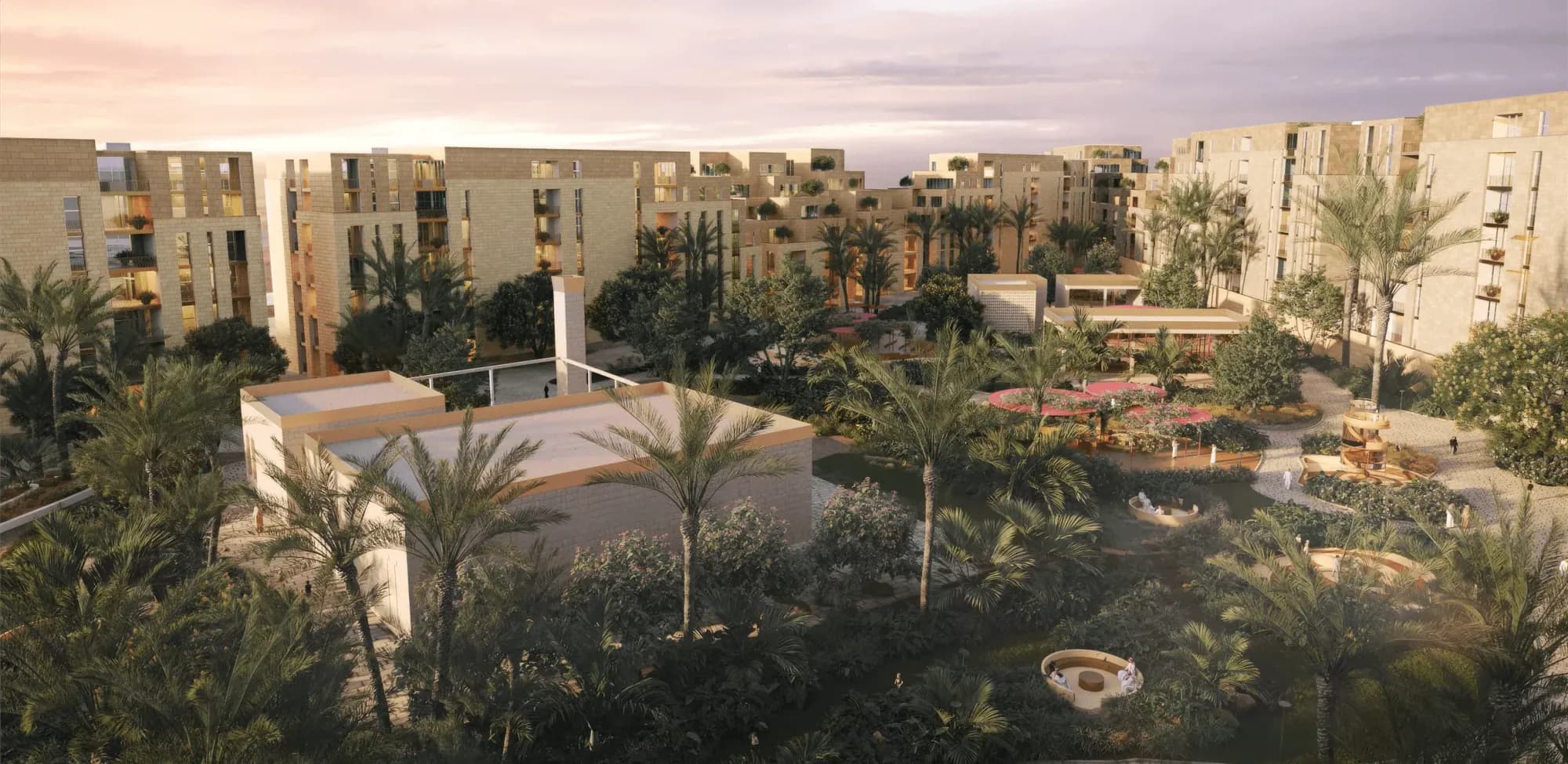
Hotels are only the start. Residential and mixed-use districts are rising to house both the visitors and the workforce that serves them, and the capital behind them has shifted from announcement to execution. Knight Frank logged about $196 billion of giga-project contract awards in 2025 alone, up 20% on the year. NEOM’s Sindalah island blends a golf course with marina living; Diriyah, the restored historic quarter on the edge of Riyadh and a UNESCO World Heritage site, is a roughly $63 billion development mixing heritage with new villas and dozens of planned hotels while drawing around two million visitors a year. The King Abdullah Financial District in Riyadh layers conference space, offices and homes into a single walkable centre. These are self-contained worlds, not standalone buildings.
Branded residences are the sharp end of that for private buyers. Vision 2030 has pulled a pipeline of more than fifty branded residential schemes into the Kingdom, attaching international hotel names to homes at the Red Sea, in Diriyah and across Riyadh, with the Trump-branded villas at Wadi Safar among the early sell-throughs. The appeal is the same one driving the hotel build-out, a managed, serviced product that travels well with international demand.
For buyers, the significance is structural. When a destination is built to be lived in year-round rather than visited for a season, values shift from holiday-home pricing toward primary-residence pricing, and Riyadh’s prime districts already showed that pull, with prices up roughly 17% to 22% in 2024. Saudi Arabia is also opening the door wider: the foreign property ownership law took effect on 22 January 2026, and the Cabinet approved the geographical zones and implementing regulations on 23 June 2026. It lets non-Saudis own property within the published mapped zones, subject to their controls and a disposal fee of up to 5%, with Makkah and Madinah specially restricted. We cover that shift in detail in our report on Saudi Arabia opening its property market to foreign buyers, and the residency route that sits alongside it in how Premium Residency has reshaped the market.
المجلة · مجانية، شهرية
أعجبك العدد؟ دع العدد القادم يصلك.
رسالة واحدة مدروسة في الشهر. إلغاء الاشتراك بنقرة واحدة.
The economic engine behind the build-out.
Tourism spending is the fuel, and it is rising on every measure that matters. Inbound spend climbed 13.8% in 2024, and total visitor spend rose 7% in 2025 to around $81 billion. The sector’s total contribution to the economy, by the WTTC’s reckoning, reached roughly $178 billion in 2025, a 7.4% gain, which makes Saudi Arabia the largest travel and tourism market in the Middle East. The government wants that contribution to keep climbing toward a far larger share of GDP by the end of the decade.
For the property market, the second-order effects matter as much as the headline. Longer average stays support short-term rentals and second-home demand. A growing tourism workforce, on its way toward roughly 2.7 million jobs, needs housing of its own. And the events pipeline locks in years of forward demand that developers can plan against: Riyadh Season every winter, the 2029 Asian Winter Games at NEOM’s Trojena, Expo 2030 in Riyadh, and the 2034 FIFA World Cup. Each one carries a hard delivery date for stadiums, hotels and the homes around them. Property here is not trailing the tourism story. In many districts, it is leading it.
The roadblocks worth naming.
Regional competition is real. Dubai, Doha and the wider Gulf are all chasing the same high-value visitor, and they have a head start in brand and infrastructure. Saudi Arabia’s answer is scale and a distinct offer, from the Red Sea’s natural setting to AlUla’s heritage, but the competition keeps the bar high.
Quality has to match quantity. Hitting a visitor target is one thing; delivering an experience that brings people back is another. The build-out is enormous, and the risk in any programme this large is that delivery and service standards lag the marketing. The Kingdom is aware of it, and the early Red Sea and Diriyah openings are the proof points it is leaning on.
Delivery timelines move. Mega-projects slip. Riyadh Air, for instance, ran later than its first announced dates before flying commercially from late 2025 and opening public service in 2026. None of this derails the trajectory, but anyone underwriting an investment on a 2030 completion date should treat the date as a plan, not a promise.
Where the visitor numbers leave the property market.
This is not a flash in the pan. The UN Tourism body has repeatedly highlighted Saudi Arabia as one of the world’s fastest-growing destinations, and the 100 million total visitors reached in 2023 was a milestone the Kingdom hit six years ahead of schedule, prompting it to raise the 2030 bar to 150 million. Property is the spine of that ambition: hotels for the international slice, homes for the 80 million domestic travellers the plan envisages, and whole districts staged for the 2034 World Cup. The Red Sea, NEOM and the financial district in Riyadh are not experiments. They are the cornerstones of a market being built to a deadline.
For an investor, that deadline is the point. A market building toward a fixed, government-backed target tends to move with more conviction than one drifting on sentiment. If you want to see where that conviction is showing up in stock you can actually buy, our Saudi Arabia developments gather the projects riding this wave, and the broader case for the Kingdom sits on the Saudi Arabia market hub.
Reading the tourism boom as a buyer.
Field notesKnow which number you are reading.
29.3 million is international; about 122 million is the total including the 93.3 million domestic trips. Most of the recent growth is domestic, so size your expectations to the right figure.
Year-round districts price differently.
Diriyah, NEOM and the financial district are built to be lived in, not just visited. That pushes pricing toward primary-residence levels rather than seasonal holiday-home levels.
The door is opening to foreigners.
Reform of foreign ownership and the Premium Residency route widen who can take part. Confirm the current rules for your target zone before you commit; the framework is still settling.
Treat 2030 dates as plans.
The trajectory is firm, but individual completion dates move. Underwrite a mega-project on its phasing and its sponsor, not on the brochure deadline.
The bottom line on Saudi tourism.
Saudi Arabia’s tourism story, around 30 million international visitors a year and roughly 122 million in total, is no blip. It is a sustained, state-backed effort that is reshaping the property market in real time. Hotels, villas and mixed-use districts are all rising to meet the wave, and the 150 million target for 2030 gives the whole programme a clear horizon. The demand is documented, the spending is rising, and the real estate is being built to hold it.
If the Kingdom is on your shortlist, it helps to read it alongside its neighbours. Our guide to expat life in Saudi Arabia covers the day-to-day of living there, and the parallel tourism story in Oman shows how a quieter Gulf neighbour is chasing the same visitors with a very different pitch.