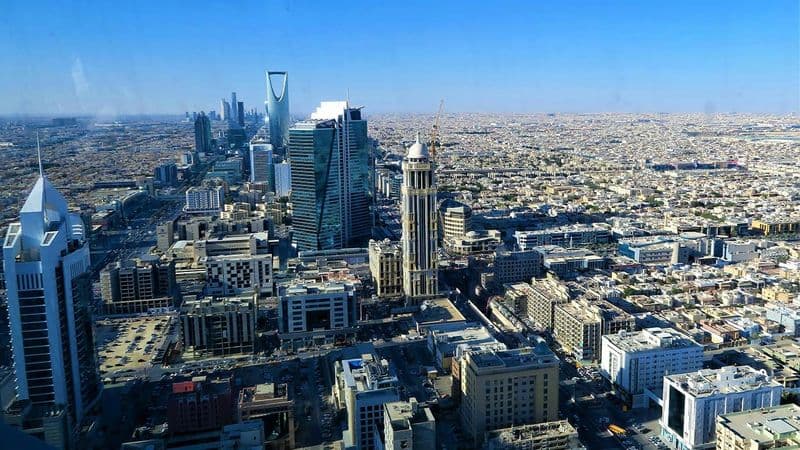
باختصار
- The structural change is the Law of Real Estate Ownership by Non-Saudis (Royal Decree M/14), in force since 22 January 2026. The Cabinet approved the geographical zones and implementing regulations on 23 June 2026, and REGA now publishes the property-level maps through Saudi Properties.
- Premium Residency is the residency route alongside it. The Real Estate Owner category needs a completed, mortgage-free residential holding appraised at SAR 4m or more, with no employer sponsor and family included, on a five-year renewable term.
- The 2024 boom has cooled. Full-year 2025 saw Riyadh residential volume fall about 31% on affordability (still SAR 96.2bn across 56,600 deals) while Jeddah rose, and a five-year Riyadh rent freeze fixed to September 2025 levels now caps the income case.
- Vision 2030 has been recalibrated: NEOM was scaled back in January 2026, with focus pivoting to delivered projects and to Expo 2030 Riyadh and the 2034 World Cup. The announced giga-project pipeline is about $1.1-1.3 trillion.
المحتويات
- 01The 2026 law that reopened the Saudi Arabia property market.
- 02Premium Residency Saudi Arabia: the visa wrapper for buyers.
- 03Saudi property prices in 2026: a market that has cooled.
- 04Rental yields and the Riyadh rent freeze.
- 05How Vision 2030 underpins the market, recalibrated.
- 06Riyadh versus Jeddah: where foreign-buyer demand sits.
- 07Risks, supply and the transaction tax law.
- 08Where to look in the Saudi property market in 2026.
- 09The final read on Saudi Arabia in 2026.
Saudi Arabia’s real estate market begins 2026 on a new legal footing. On 22 January 2026 the Law of Real Estate Ownership by Non-Saudis, Royal Decree M/14, took effect, replacing the 2000 framework. On 23 June 2026 the Cabinet approved the geographical zones and implementing regulations, and REGA now publishes the property-level maps through Saudi Properties. Non-Saudi individuals and companies can hold freehold title within those approved zones rather than by case-by-case exception. Premium Residency is the separate residency route that can follow a qualifying completed purchase. What follows sets out where that leaves Riyadh and Jeddah in 2026, against a 2024 boom that has cooled into a measured rebalancing, drawing on Knight Frank, Cavendish Maxwell, Deloitte, the IMF and official sources.
The 2026 law that reopened the Saudi Arabia property market.
For two decades, foreign access to Saudi real estate ran case by case. The new Law of Real Estate Ownership by Non-Saudis changes that. In force since 22 January 2026, with geographical zones and implementing regulations approved on 23 June 2026, it grants non-Saudi individuals and companies the right to hold freehold title within the approved mapped zones. In Makkah and Madinah, ownership is restricted to Muslim individuals and qualifying entities under the applicable controls. This is the single biggest structural change in the market, and the reason 2026 is the year to read it freshly. For the legal mechanics, see our explainer on the law of real estate ownership by non-Saudis.
The scale of the market that has reopened is real, once the right numbers are used. During 2024, total real estate transactions across all asset classes rose about 37% in volume to just over 236,690 deals, with total value up about 27% to SAR 267.8 billion, on Knight Frank’s Saudi Report 2025. Deloitte put residential sales across Riyadh, Jeddah and Dammam at SAR 118 billion ($32 billion) for the full year. Those are the load-bearing figures behind the headlines, and they describe a deep market rather than a single-quarter spike.
Premium Residency Saudi Arabia: the visa wrapper for buyers.
Premium Residency, a Vision 2030 program, is now the residency route that pairs with the ownership law. It runs across five category-based residencies, Special Talent, Gifted, Investor, Entrepreneur and Real Estate Owner, each on a five-year renewable term, alongside two flagship options: a permanent residency for a one-off SAR 800,000, and an annual residency at SAR 100,000 a year. For property buyers, the Real Estate Owner category is the relevant door. It requires a fully constructed, unmortgaged, certified-valued property, single or as a portfolio, worth at least SAR 4 million (about $1.07 million), with no employer sponsor and family included, at a category fee of around SAR 4,000 a year. The threshold must be maintained for the residency to hold.
The terms suit an overseas buyer. There is no personal income tax in Saudi Arabia, which protects net returns, and the visa removes the traditional employer sponsorship for qualifying holders. The property route is one tier among several, framed as five-year renewable rather than lifetime by default, the permanent option being the separate SAR 800,000 category. For a fuller read on whether the timing works, see our analysis of the opening of the market to foreign buyers.
- Real Estate Owner tier. A completed, mortgage-free residential holding appraised at SAR 4 million or more can qualify for Premium Residency, linking the residency route directly to real estate.
- No sponsor requirement. Premium Residency removes the traditional employer sponsorship for qualifying holders.
- Family residency. The visa extends to immediate family, which broadens the buyer pool to relocating households.
- No personal income tax. Saudi Arabia levies no personal income tax, which supports net returns for foreign holders.
Saudi property prices in 2026: a market that has cooled.
The 2024 surge has settled. On Cavendish Maxwell’s full-year 2025 data, Riyadh residential recorded 56,600 transactions worth SAR 96.2 billion, with volume down about 31% year on year as prices reached a peak and affordability tightened. Jeddah moved the other way, rising to 30,500 transactions worth SAR 36.6 billion, while Dammam grew about 19% to 9,500 deals. Price growth has moderated rather than reversed: Riyadh apartments rose about 6.6% and villas about 9.7% over 2025, while Jeddah was in the low single digits, with apartments up about 1.2% and villas about 3.2%.
Read together, that is a rebalancing, not a downturn. Knight Frank notes Riyadh prices appear to have hit a new peak, and activity softened in late 2025 as buyers waited for the foreign-ownership framework to land. With the law now in force, analysts expect activity to re-accelerate through 2026.
Source: Cavendish Maxwell, Saudi Arabia Residential Market Performance 2025. Full-year year-on-year price change. Indicative; not investment advice.
Rental yields and the Riyadh rent freeze.
On income, Saudi Arabia still reads well by regional standards, but with a clear 2026 caveat. Gross residential yields run near 8.9% in Riyadh and about 7.9% in Jeddah on the STC Real Estate Index, with a national average near 6.8% in early 2026, on Global Property Guide. The caveat is policy: a royal decree of 25 September 2025 imposed a five-year rent freeze on all residential and commercial property within Riyadh’s urban boundary, fixing rents at their 25 September 2025 levels until 2030, with violations fined up to twelve months’ rent and scope for the regulator to extend it to other cities.
That matters for the income thesis. A headline Riyadh yield near 9% is a starting position, not a growing one, while rents are capped to 2030. Buyers underwriting Riyadh on rising rents should reset the assumption to a frozen base, and weigh capital growth and selection more heavily than yield expansion. Jeddah, outside the freeze for now, keeps more of the conventional income story.
| Metric | Riyadh | Jeddah |
|---|---|---|
| Residential transactions, 2025 | 56,600 | 30,500 |
| Residential value, 2025 | SAR 96.2bn | SAR 36.6bn |
| Apartment price growth, 2025 | +6.6% | +1.2% |
| Villa price growth, 2025 | +9.7% | +3.2% |
| Indicative gross yield | ~8.9% | ~7.9% |
Sources: Cavendish Maxwell 2025 (transactions, value, price growth); STC Real Estate Index and Global Property Guide (gross yields). Indicative; confirm before relying on any single number.
How Vision 2030 underpins the market, recalibrated.
Vision 2030 still anchors demand, but the picture is more disciplined than the early hype. NEOM was materially restructured and scaled back in January 2026: spending on nearly every project was frozen and put under reassessment, headcount cut to about a third, sub-projects dispersed to other state entities, and The Line drastically reduced, with national focus pivoting to Riyadh Expo 2030 and the 2034 FIFA World Cup. The credible reading anchors the demand story on what is being delivered, not on a single future city.
Delivery is where the confidence sits. Red Sea Global’s first phase is operational with hotels open, the King Abdullah Financial District in Riyadh is occupied, ROSHN is delivering housing at scale, and Diriyah and Qiddiya are advancing. The announced giga-project pipeline is now cited at about $1.1 to $1.3 trillion, the largest single-country construction programme, and 2025 contract awards rose about 20% to $196 billion, on Knight Frank. Tourism backs the residential and hospitality case: Saudi Arabia drew about 122 million visitors in 2025, up about 5% year on year with roughly SR300 billion in spend, on track toward a revised national target of 150 million visitors by 2030.
The structural driver in 2026 is the new ownership law, which makes freehold a statutory right for foreign buyers. Premium Residency is the visa that follows the purchase, not the cause of the shift.
Riyadh versus Jeddah: where foreign-buyer demand sits.
Riyadh is the capital and the scale play. Its population is projected to reach about 9.6 million by 2030, on Knight Frank, up from around 7 million in 2022, and the city is set to deliver roughly 57,000 new homes across 2026 and 2027. The 2025 picture is one of high value on cooling volume, SAR 96.2 billion across 56,600 deals with volume down about 31%, and rents now frozen to 2030. Jeddah is the lighter, rising market: residential value of SAR 36.6 billion across 30,500 deals in 2025, with low single-digit price growth and a Red Sea position that favours tourism-linked and waterfront demand.
Which city suits an investor depends on the mandate. Riyadh fits buyers underwriting long-run growth and institutional-grade supply, accepting a capped rent base. Jeddah’s coastal edge favours lifestyle-led and tourism-linked demand, and keeps more of the conventional income story for now. Both sit inside the new ownership framework, so the choice is one of strategy rather than access.
Risks, supply and the transaction tax law.
The picture is not frictionless. Affordability has already bitten in Riyadh, where 2025 volume fell about 31% as prices peaked, and a strong supply pipeline of roughly 57,000 homes across 2026 and 2027 will need to be absorbed. The Riyadh rent freeze caps income growth in the capital to 2030. On the tax side, the Real Estate Transaction Tax Law took effect on 9 April 2025 at a 5% rate, on EY and PwC, with late-payment penalties reduced to 2% a month and capped at 50% of the unpaid tax, which steadies investor expectations on cost.
The wider economy supports the read, with diversification real but moderating. The IMF recorded non-oil real GDP growth of 4.5% in 2024, easing to a forecast of about 3.4% to 4% in 2025, with the non-oil sector now around 55% to 56% of GDP. Looking forward, analysts project roughly 5% to 7% national residential price growth over the next twelve months, with Riyadh higher at around 8% to 10%, driven by Expo 2030 preparation and job creation, and the foreign-ownership law expected to re-accelerate activity through 2026.
Where to look in the Saudi property market in 2026.
The prime segment carries the clearest case. In Riyadh, premium residential zones such as the area around King Salman Park sit close to the deepest demand, though buyers should underwrite Riyadh on capital growth and selection rather than rising rents while the freeze holds. In Jeddah, Red Sea-facing homes are tied to tourism milestones including the AFC Asian Cup, which Saudi Arabia hosts in January 2027 with Jeddah among the venues. Masterplan-backed addresses at the scarce end of supply, where finite stock and government backing support pricing over time, remain the disciplined entry point.
Timing still matters. The strongest launches release in phases, and the best units in masterplan-backed addresses move early. The discipline is consistent: buy at launch stage, in locations underwritten by a credible developer and a government-backed masterplan, and hold through delivery. For a current shortlist of where that thesis is live, see our guide to the top off-plan projects in Saudi Arabia.
The final read on Saudi Arabia in 2026.
Saudi Arabia’s property market in 2026 reads as a reopening on new legal foundations, not a runaway boom. The new ownership law makes freehold a statutory right for foreign buyers, Premium Residency is the visa that follows the purchase, and the prime segment carries the strongest case. The 2024 boom has cooled into a 2025 rebalancing, Riyadh rents are capped to 2030, and Vision 2030 itself has been recalibrated toward delivered projects, Expo 2030 and the 2034 World Cup. The figures, from the SAR 267.8 billion 2024 market to the roughly $1.1 to $1.3 trillion pipeline, describe a market early in a long cycle rather than late in a short one. For investors, the work now is selection: the right address, the right developer, and the patience to hold through the build. Every figure here is indicative and not investment advice.
استشارة
تحدّث إلينا على انفراد.
مستشار من أومنيا حول التوافر والهيكلة والتوقيت في هذه الأسواق.
 متاحوادي صفارريانة ترامب مانشنز، وادي صفارتبدأ من4,294,017 £النوعمساكناستكشف الإقامة