باختصار
- Oman real estate is in a clear uptrend on the hard national numbers: transaction value reached OMR 678.1 million by end-March 2026, up 18.4% year on year across 15,895 sale contracts, after January 2026 traded value jumped 27.1% with sales contracts up 37.5%, per the NCSI and Savills.
- Muscat is an expat-majority capital. Of about 1.5 million residents at end-2024, roughly 915,000 were non-Omani, which underpins the rental demand that high net worth buyers underwrite, per the NCSI.
- The Royal Oman Police provides a two-year residence-visa service for owners of residential units in Integrated Tourism Complexes. Separately, the Ministry of Commerce, Industry and Investment Promotion describes a renewable ten-year Golden Residency programme with a minimum investment of OMR 200,000; its property route covers ready-made units in ITCs. Confirm the applicable route, the specific home and the application requirements before relying on residency as part of a purchase.
- Prime gross yields run about 5-8% at Al Mouj and Muscat Hills, below the headline 6-9% sometimes quoted, with Al Mouj four-bedroom villas renting near OMR 1,770 a month and rising, per Savills Q1 2026. Illustrative appreciation in prime areas reads at about 3-7%.
المحتويات
- 01Why high net worth Oman demand is rising.
- 02How Muscat property investment works for foreigners.
- 03Muscat Hills and the prime ITC communities.
- 04Muscat property investment: yields, read honestly.
- 05Gulf wealth migration and the Muscat opportunity.
- 06Risks and friction to weigh.
- 07Omnia investment recommendations.
- 08Looking forward across Oman and the Gulf.
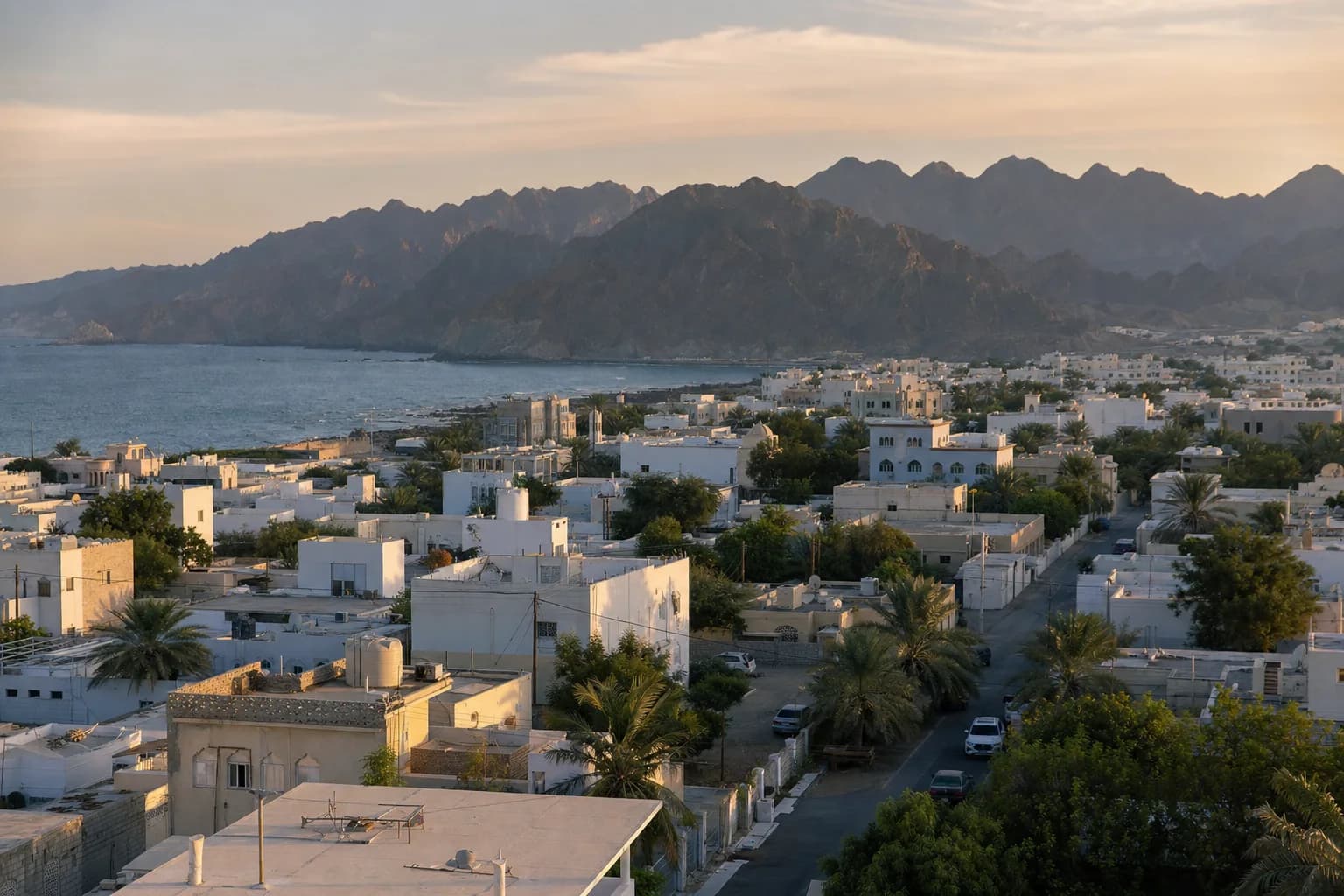
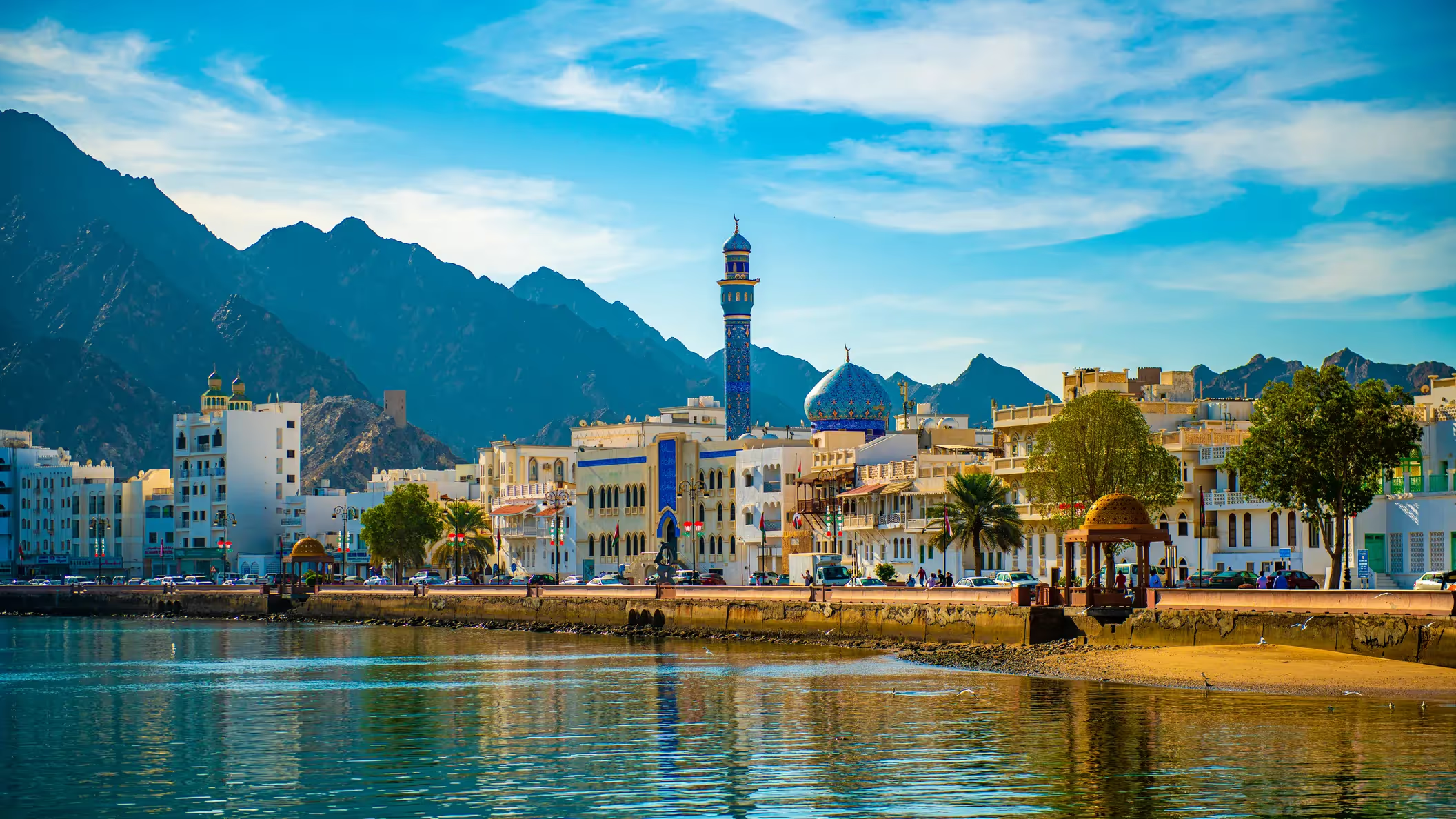
The Muscat property market is drawing a new kind of buyer in 2026: high net worth individuals from across the Gulf Cooperation Council who already own in Dubai, Riyadh or Doha and are now looking for value beyond the headline markets. As Oman’s capital, Muscat pairs a stable, low-tax setting with entry prices that sit well below the prime tiers of its neighbours, and that gap is the whole argument. Saudi, Emirati, Qatari, Kuwaiti and Bahraini capital is treating the city as a complementary second market rather than a primary bet, a place to diversify into homes whose rental evidence and any residency route require separate checks.
This report stays on that demand-side question. Rather than re-run the supply and tourism story covered elsewhere in our Oman coverage, it sets out why Gulf wealth is moving toward Muscat, what the freehold route actually offers a foreign buyer, where the demand is concentrated, and an honest read of the yields and the friction. It draws on the National Centre for Statistics and Information, Savills, the Henley Private Wealth Migration Report and on-the-ground agency data, and corrects several round figures the older readings carried.
The timing matters. Three developments since late 2025 have sharpened the case for Gulf buyers. Oman relaunched its Golden Residency on 31 August 2025, a ten-year residency from OMR 200,000 that puts property at the centre of long-term residency. The central bank trimmed mortgage rates through 2025, lifting financed demand. And a period of regional volatility in early 2026 pushed Emirati capital toward calmer markets, with UAE buyers rising from roughly a tenth of monthly Oman sales in 2025 to about a third of March 2026 transactions, per AGBI. The result is a national market that opened 2026 trading firmly higher.
Source: National Centre for Statistics and Information (NCSI), via Economy Middle East. Total real estate traded value, January, year on year. Indicative; not investment advice.
Why high net worth Oman demand is rising.
A value gap against Dubai. Muscat’s pull starts with price. Prime communities such as Al Mouj quote at roughly OMR 700-1,200 per square metre, with the top addresses around OMR 900-1,300 per square metre, per agency data. Villas in the prime tier run from about OMR 180,000 to beyond OMR 500,000, while a sea-facing two-bedroom apartment can be had near OMR 120,000. Against Dubai’s prime areas, where comparable product runs into the millions of dirhams, that is a different order of entry for similar quality, and it is the single clearest reason Gulf buyers are widening their search to Oman.
A stable, low-tax base. Oman levies no personal income tax, no capital gains tax on property and no annual property tax, which preserves net returns for an individual investor. The macro backdrop is steady rather than spectacular: Savills put nominal GDP at OMR 42.1 billion by the close of 2025, up about 4.6% year on year, and the diversification under Vision 2040 is showing, with non-oil activity reaching OMR 28.7 billion in 2025, around 72% of the economy, per the NCSI. Oman’s investable wealth is estimated to rise from about USD 80 billion in 2024 toward USD 110 billion by 2030. Lower borrowing costs help too: the central bank trimmed mortgage rates in 2025, indicative 20-year home loans in Muscat run near 5.1%, and the number of mortgaged purchases rose about 10% to nearly 23,000 across Oman in 2025, per AGBI. For buyers prioritising calm over volatility, that profile reads as a feature.
An expat-majority capital. The demand that high net worth buyers underwrite is real and resident. Muscat governorate held about 1,499,549 people at the end of 2024, up 3% on the year, of whom roughly 915,457 were non-Omani, per the NCSI. National population reached 5.36 million by January 2026. An expatriate majority in the capital, weighted toward professionals and corporate tenants, is what sustains the rental market that an investor relies on, and it is a sounder basis for the thesis than the demographic projections older readings leaned on.
How Muscat property investment works for foreigners.
Freehold through ITCs. Check ownership eligibility and title for the specific home before reserving. Ask for the scheme’s approval, the exact title or usufruct instrument, and written confirmation that it is available to a buyer in your circumstances. The homes listed here do not all use the same ownership route. Selected Muscat communities include Al Mouj, Muscat Hills and the developing Yiti coast. These examples do not establish eligibility for every home.
What the ITC route actually grants. Three features make the freehold zones the centre of foreign demand.
- Residency requirements. The Royal Oman Police provides a two-year residence-visa service for owners of residential units in Integrated Tourism Complexes. Separately, the Ministry of Commerce, Industry and Investment Promotion describes a renewable ten-year Golden Residency programme with a minimum investment of OMR 200,000; its property route covers ready-made units in ITCs. Confirm the applicable route, the specific home and the application requirements before relying on residency as part of a purchase.
- Clean resale. ITC property can be sold to any qualifying buyer, Omani or foreign, at any time without government approval, which keeps the exit liquid in a way some restricted markets do not.
- Known costs and a build clause. Registration fees run roughly 3-5%, with service charges depending on the community, per agency guidance. One caveat the brochures skip: an undeveloped ITC plot usually carries a construction deadline, commonly four years, and missing it can trigger penalties, so the off-the-shelf villa or apartment is the simpler entry for most buyers.
The leasehold caveat. Outside the ITCs, popular districts such as Qurum are largely leasehold for foreigners, a distinction the older readings blurred. A Gulf buyer chasing the Muscat thesis is, in practice, buying into the ITC communities, which is where this report focuses.
Muscat Hills and the prime ITC communities.
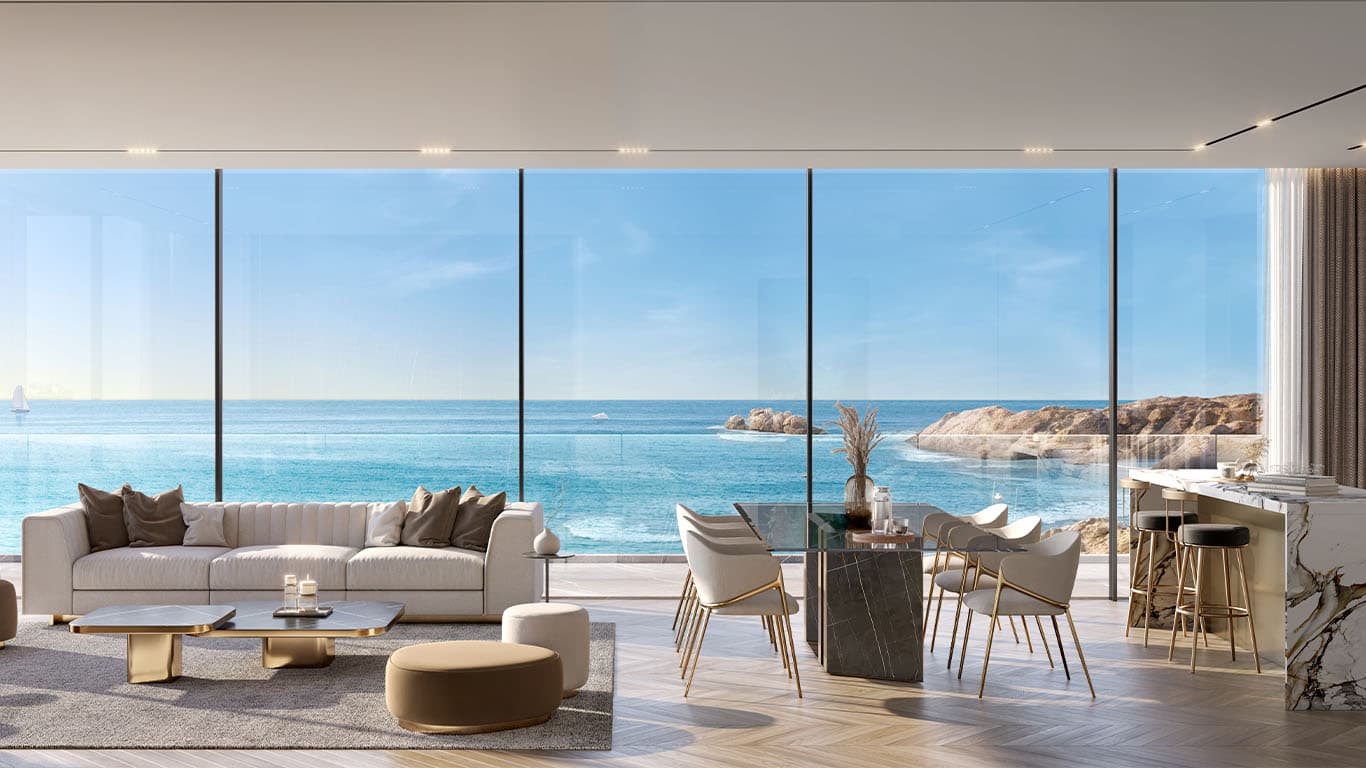
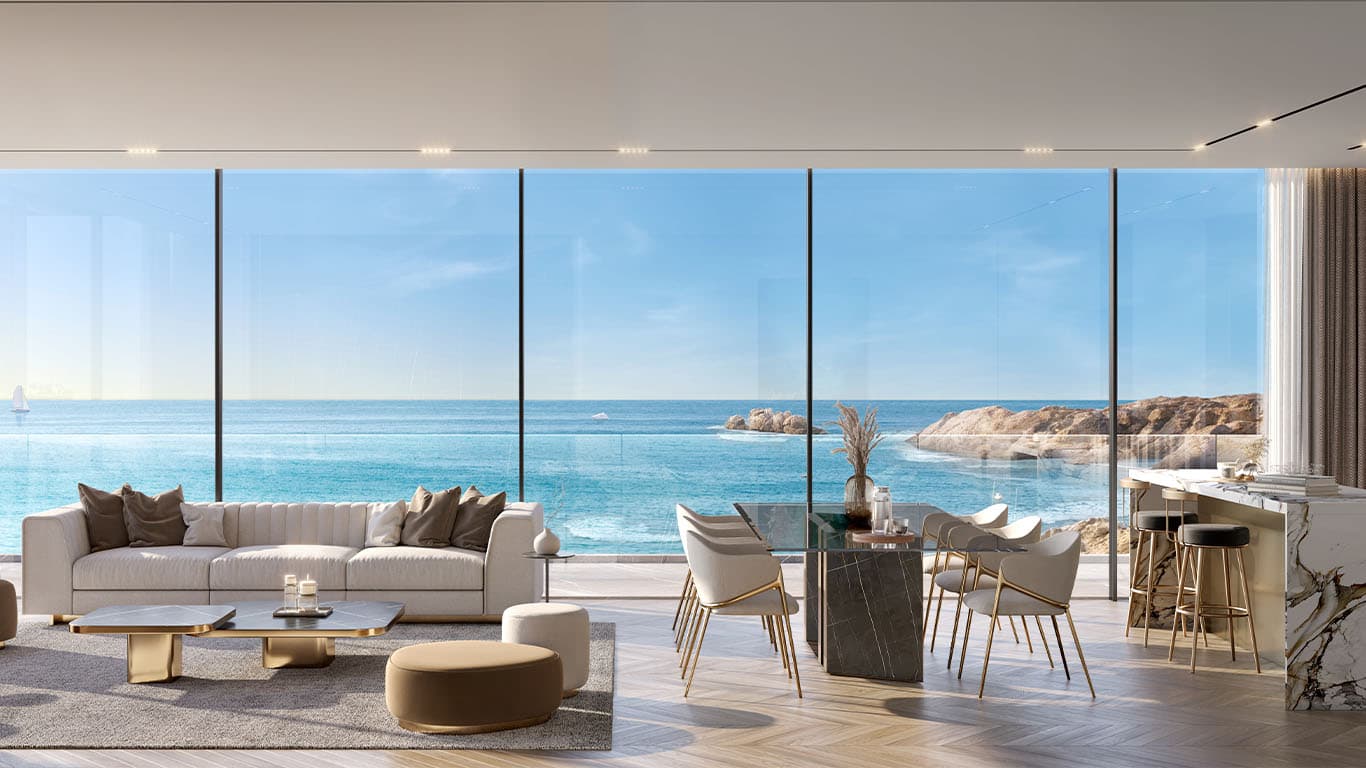
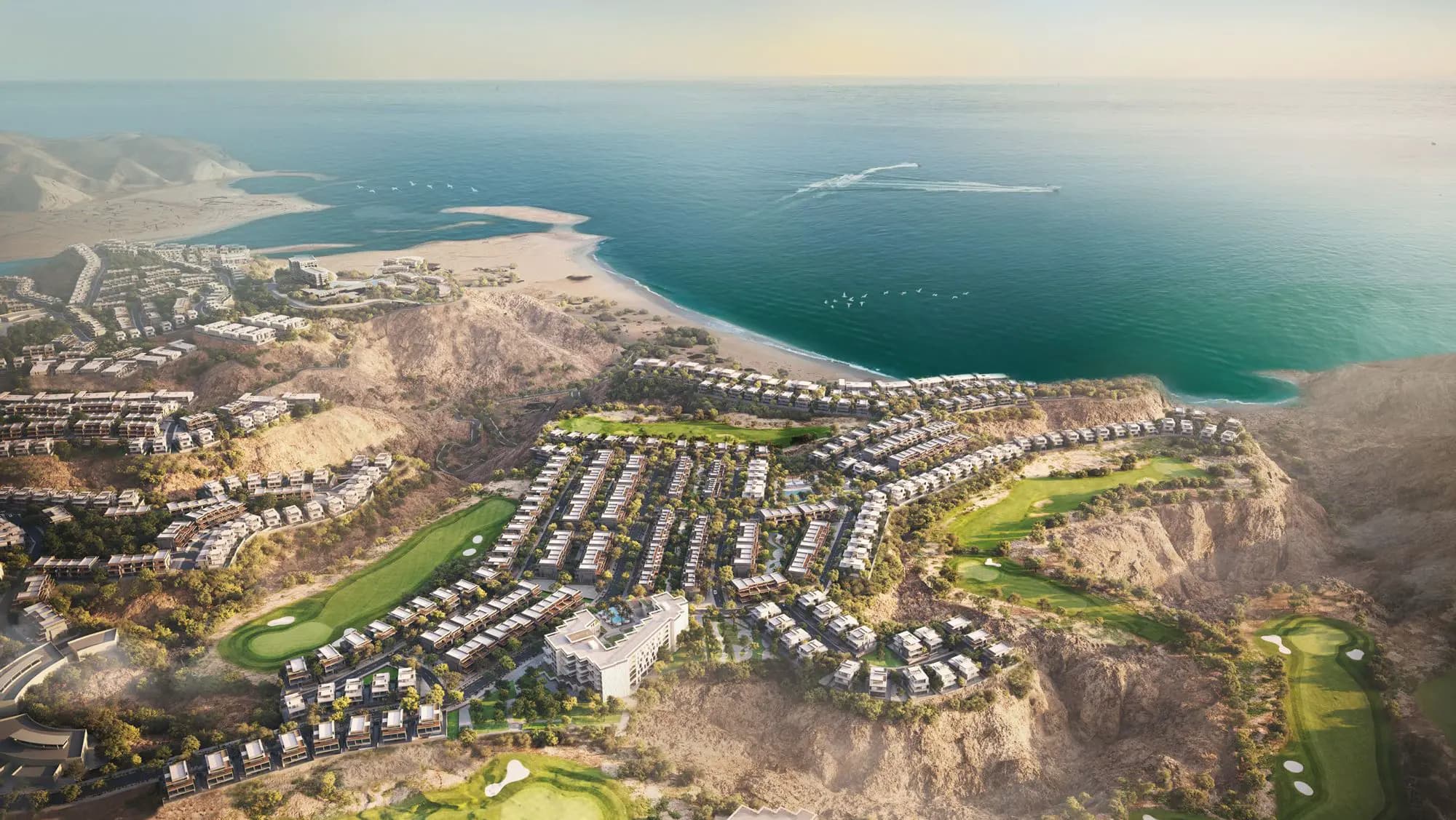
Al Mouj Muscat. The waterfront ITC is the benchmark for foreign ownership in the capital, with a marina, an 18-hole links golf course, schools, retail and beach clubs. Savills put Al Mouj four-bedroom villa rents at about OMR 1,770 a month and two-bedroom apartments near OMR 710 a month in the first quarter of 2026, up 2% and 3% on the quarter respectively, with Al Mouj holding the rental premium across the capital. That rents kept climbing into 2026, rather than plateauing, is the clearest sign of lifestyle-led demand. Saudi and Emirati buyers favour it for the combination of amenity, liquidity and residency.
Muscat Hills. The second proven ITC is built around a championship golf course with Al Hajar mountain views. Five-bedroom villas run from about OMR 250,000 to OMR 300,000, with homes near the clubhouse approaching OMR 400,000 and apartments from roughly OMR 65,000, per agency data. Agencies quote gross yields of about 5-7%, peaking near 8% around golf events, with appreciation read at about 6-8% a year. It draws corporate tenants and Gulf families wanting a quieter, golf-led setting than the waterfront.
The new freehold pipeline. The proven pair is no longer the whole field. A cluster of newer ITCs is opening foreign-ownable stock around the Yiti coast and the southern bays. AIDA, a hilltop community by Dar Global with OMRAN set 130 metres above the Sea of Oman, lists three- to seven-bedroom villas from about USD 422,000 with a first phase due around 2027. The Sustainable City Yiti, an OMRAN venture with Diamond Developers, targets a net-zero operating model and full operation in 2026. Muscat Bay, by OMRAN with Saraya, and Jebel Sifah, by Muriya south of the capital, round out a pipeline that gives Gulf buyers more freehold choice than at any point in the cluster history. For first-time Muscat buyers the established communities still carry the deepest resale market, but the new schemes widen the entry points.
The wider field. Beyond the freehold communities, commercial and mixed-use districts such as Qurum and Al Khuwair carry strong rental demand from expatriate professionals, and value-led areas around Seeb and the airport corridor offer cheaper entry, though most are leasehold rather than freehold for foreigners. For a high net worth buyer the practical universe is the ITCs first, with the rest read as rental context.
Muscat property investment: yields, read honestly.
What the prime yields really are. The headline figure of 6-9% sometimes quoted for Oman overstates what prime stock pays. The honest read at Al Mouj and Muscat Hills is a gross yield band of about 5-8%, with premium waterfront villas closer to 4-5.5% because capital values have run ahead of rents, and only cheaper or seasonally let stock reaching toward 9%. Al Mouj reports strong occupancy of about 80-85%, well above the wider Muscat average, which supports the case even where the gross yield is moderate.
Appreciation, illustrative. Capital growth in the prime areas reads at about 3-7% on a conservative view, with some agency data putting Muscat Hills nearer 6-8% a year. These are illustrative ranges, not guarantees, and they depend heavily on the specific community and unit. The point for a Gulf buyer is that Muscat is a steady-compounding market, not a momentum trade.
Where Muscat sits against its neighbours. Set against the wider region, Muscat competes on value rather than scale. Dubai and Abu Dhabi prime stock has historically quoted yields in the mid-to-high single digits, and Riyadh saw strong price growth through 2024 and 2025. Muscat will not out-trade any of them on volume. Its differentiation is the entry price, the residency visa and a calmer market, which is exactly the diversification role Gulf wealth is assigning it.
Muscat is not a market a high net worth buyer chases on a 9% headline. It is one they hold for value, a residency visa and a calmer ownership profile than Dubai, at a fraction of the entry price.
Gulf wealth migration and the Muscat opportunity.
Wealth is moving into the Gulf. Muscat’s demand sits inside a regional wealth shift. The UAE remained the world’s number-one destination for migrating millionaires in 2025, with a record net inflow of about 9,800, per the Henley Private Wealth Migration Report. More broadly, an estimated 15,000 high net worth individuals relocated to the GCC in 2024, up about 20% on the year, with around 18,000 projected for 2025. Oman captures a smaller share of that flow than the UAE, but its draw within it is precisely its relative affordability and its expanding waterfront stock.
Why Gulf buyers specifically. For a buyer who already holds Dubai or Riyadh, Muscat answers three needs at once: a second base with a residency route to investigate, rental exposure to an expat-majority capital, and geographic diversification within a familiar regulatory and cultural setting. Cultural proximity matters here. A Saudi or Emirati family treats Muscat as an extension of a region they know, not a foreign market to learn from scratch, which lowers the perceived risk of a second-market purchase.
The Emirati flow has stepped up. That diversification logic turned concrete in early 2026. UAE buyers, who had averaged about 12% of monthly Oman sales through 2025, jumped to roughly a third of March 2026 transactions as regional volatility pushed capital toward a steadier market, per AGBI. Brokers report the typical UAE buyer comes from Dubai and is taking one- to three-bedroom apartments, with the capital their first choice and Sohar second for its proximity to the Emirates. The flow lifted national sales for the month to around USD 550 million. It is a reminder that Muscat behaves as a relief valve for Gulf wealth when the headline markets wobble.
The national market is trading up. The demand is showing in the numbers. Oman’s total real estate transaction value reached OMR 678.1 million by end-March 2026, up 18.4% year on year across 15,895 sale contracts, with mortgage-backed value up 16.4% to OMR 369.3 million over 6,603 contracts, per the NCSI. That followed a January 2026 that opened 27.1% higher in traded value year on year, with sales contracts up 37.5%, and an end-November 2025 base of about OMR 2.8 billion. This is a market gaining, not stalling, and Muscat is its centre of gravity.
Risks and friction to weigh.
Ownership is confined to ITCs. The freehold restriction is the central constraint. A foreign buyer’s real choice set is the ITC communities, which narrows the field and concentrates pricing power in a few developers. The process is also more bureaucratic than Dubai’s near-seamless system, so engaging a local adviser is close to non-negotiable and adds upfront cost.
A smaller, thinner market. Muscat is a fraction of the scale of Dubai or Abu Dhabi. Fewer comparable sales means pricing is less transparent and exits can take longer, particularly above the OMR 400,000 mark where the buyer pool thins. Demand for the best prime units can outrun supply while weaker stock sits, so selection matters more than in a deep, liquid market.
Yields are moderate and oil still matters. Prime gross yields of about 5-8% are competitive but not exceptional, and the 6-9% figure circulated in older readings flatters the prime tier. Oman’s economy, while diversifying under Vision 2040, remains partly tied to oil, so a sustained downturn in prices could slow infrastructure spending and soften sentiment. None of this breaks the thesis, but it argues for buying on the real numbers rather than the brochure.
Omnia investment recommendations.
Four plays stand out for Gulf buyers approaching Muscat in 2026.
- Anchor in the proven ITCs. Al Mouj and Muscat Hills offer established amenities and rental comparables. For a first Muscat purchase, the established freehold communities lower the resale and tenancy risk that an untested scheme would carry.
- Underwrite on 5-8%, not 9%. Model prime stock to the honest yield band and treat the higher headline figures as cheaper-stock or seasonal outliers, not a base case.
- Size the purchase to the visa you want. MoCIIP describes a renewable ten-year programme with a minimum investment of OMR 200,000; its property route covers ready-made units in ITCs. The home and application must satisfy the programme requirements.
- Use the residency, hold for value. Treat Muscat as a steady-compounding diversification with any residency application checked separately, paired with a primary holding in Dubai, Riyadh or Doha, rather than a momentum trade.
- Engage local counsel early. The ITC route and the property residency process reward a seasoned local adviser. Build that cost in from the start to avoid delays and missteps.
Looking forward across Oman and the Gulf.
The Muscat property market in 2026 is a calmer, value-led entry into Gulf property, and that is exactly why high net worth buyers who already hold the headline markets are turning to it. ITC homes with ownership and residency requirements to verify, an expat-majority capital that sustains rents, and a national market trading up form a real foundation, while the smaller scale and the freehold restriction set sensible limits. Bought selectively in the proven communities and underwritten on the actual yields, Muscat earns its place as a second Gulf market rather than a first.
The demand-side read here sits alongside the supply and tourism story in our Oman price-drivers report and our Oman tourism analysis. For the full market context, see the Oman market hub and the current Oman developments. For investors building Gulf exposure, Muscat is the quiet diversification that the region’s wealth has started to price in. Every figure here is indicative and not investment advice.
استشارة
تحدّث إلينا على انفراد.
مستشار من أومنيا حول التوافر والهيكلة والتوقيت في هذه الأسواق.
 متاحيتي، مسقطعايدة، عُمانتبدأ من200,000 £النوعمساكناستكشف الإقامة