In brief
- Oman house prices have turned hard. After a soft 2024, the residential index rose 7.3% year on year in the first quarter of 2025, then 17.3% by the third quarter, with full-year 2025 residential prices up about 18.7% and apartments up 22.4%, per NCSI data reported by Arabian Business and Arab News. Three straight quarters of gains read as a cycle, not a spike.
- The flagship Hafeet Rail, the 303 km USD 3bn line from Sohar to Abu Dhabi (a roughly 238 km cross-border build), reached about 40% completion and entered track-laying in 2026, with commissioning targeted around the end of the decade and no firm date confirmed. It is a joint venture of Etihad Rail, Oman Rail and Mubadala.
- The Muscat Metro, about 50 km and 36 stations, sits in feasibility with details promised in early 2026, while the Batinah Expressway has carried traffic since 2018 and about 1,120 km of new road is under build in 2026. Roads, not rail, carry the near-term effect: Muscat residential land alone rose 41.3% in the fourth quarter of 2025.
- Oman residential real estate is sized at about USD 4.78bn in 2025, projected toward USD 7.42bn by 2030 on a 9.19% CAGR, per Mordor Intelligence. Duqm and Salalah ports, the Sultan Haitham City build-out and ITC areas with residency requirements to verify anchor the corridor case.
Contents
- 01The UAE-Oman railway and cross-border connectivity.
- 02Roads and the Oman infrastructure real estate effect.
- 03The Muscat Metro and urban property values.
- 04Ports, aviation and the Duqm logistics corridor.
- 05New cities where connectivity meets housing demand.
- 06Quantifying the property value uplift in 2026.
- 07Where the corridor premium is actually landing.
- 08Risks and challenges to weigh.
- 09Looking forward across Oman and the Gulf.
In 2026, the question of how Oman transport and connectivity projects lift property values has a clearer answer than the marketing once gave. Oman real estate transactions climbed to about OMR 3.13 billion by November 2024, up roughly 28% year on year, and full-year 2024 ran near OMR 3.3 billion, around 29.5% higher, per the National Centre for Statistics and Information reported by Arab News. Prices then turned decisively. The residential index rose about 7.3% year on year in the first quarter of 2025, accelerated to 17.3% by the third quarter and held at 13.9% overall in the fourth, with full-year residential prices up around 18.7% and apartments up 22.4%. Three consecutive quarters of gains read as a cycle rather than a spike. The pattern is consistent: where access improves, demand and price follow.
The harder part is separating what is built from what is announced. Some of the corridor story is real and delivered, such as the Batinah Expressway and the ports at Sohar, Duqm and Salalah. Some is under construction with an end-of-decade horizon, such as the Sohar to Abu Dhabi railway. And some is still in feasibility, such as the Muscat Metro. This report sets out where each project actually stands in 2026 and where the property-value uplift is genuinely landing, drawing on Mordor Intelligence, Arab News and NCSI data, project sources, and the Carnegie Endowment, with an honest read of what could not be verified.
Source: Mordor Intelligence, Oman residential real estate, 2025 to 2030. Forecast illustrative; not investment advice.
The UAE-Oman railway and cross-border connectivity.
Hafeet Rail, the headline project. The most-cited piece of the pipeline is the cross-border railway, now branded Hafeet Rail. It is a 303 kilometre line linking Sohar in Oman to Abu Dhabi, of which a roughly 238 kilometre cross-border segment to Sohar Port is the active construction scope, estimated at about USD 3 billion, and a joint venture of Etihad Rail, Oman Rail and Mubadala. The engineering is substantial: two tunnels of about 2.5 kilometres each and 36 bridges, with more than 27 million cubic metres of earthworks and over 100,000 cubic metres of concrete already placed. Passenger services are designed to cut the Sohar to Abu Dhabi journey to about one hour and forty minutes at up to 200 km/h, with freight running at up to 120 km/h.
Where it actually is. This is where older readings overreached. Construction began in 2024, reached about 40% completion by April 2026 and entered the track-laying phase that year, with active work across Al Ain, Al Buraimi, Sohar and the Wadi Al Jizzi corridor and around 10 million safe man-hours logged. Commissioning is targeted around the end of the decade, with no firm operational date confirmed, and certainly not in the near term: the GCC-wide 2030 network ambition is a regional target, not a Hafeet Rail completion date. For property, that means the rail premium is a next-decade story: land near the future Sohar terminal and along the industrial corridor is positioning early, but the access itself is years out. Underwriting that prices in a finished line today is premature.
Roads and the Oman infrastructure real estate effect.
Roads carry the near-term uplift. The clearest connection between Oman infrastructure and real estate values in 2026 runs through roads, because they are delivered. Three projects matter.
- Al Batinah Expressway. The roughly 256 kilometre, eight-lane expressway, built at about RO 800 million (around USD 2.1 billion) and open since 2018, runs from the Muscat Expressway at Halban to the UAE border at Khatmat Malaha, passing Sohar Port. It has already pulled logistics and residential demand toward the Batinah coast, the same coast the future Hafeet Rail terminal will serve.
- Nizwa-Bahla dual carriageway. Tendered in 2025, this is a roughly 40 kilometre dualisation from the Daris roundabout to Jabrin in Al Dakhiliyah, intended to lift commercial, tourism and residential activity across the interior and improve access to the heritage sites around Bahla and Nizwa.
- Wider road programme. Oman continues to spend heavily on road building and dualisation. An OR 1 billion programme worth about USD 2.6 billion targets transport infrastructure, per AGBI, and around 1,120 kilometres of road sit under implementation in 2026 at a cost of roughly RO 1.2 billion, knitting the governorates more tightly into the Muscat and Sohar economies.
The mechanism is the same one Muscat saw in the early 2000s, when initial highway building lifted peripheral land. Improved access shortens commutes, opens new districts to development and reprices the land they sit on. Roads, not rail, are where that effect is visible now.
The Muscat Metro and urban property values.
A first urban rail, still on paper. The Muscat Metro is the project most likely to reprice urban property if it proceeds, because metro stations historically lift values within walking distance. The proposal is for about a 50 kilometre network with around 36 stations, running between Sultan Haitham City and the Ruwi central business district, passing through Muscat International Airport and serving the planned downtown districts of Ghala and Al Khuwair. It would be Oman’s first urban rail system.
Read it as feasibility, not delivery. As of early 2026 the metro sits in the feasibility and planning stage, with the government promising to announce full details within two months of a January 2026 statement. There is no confirmed route alignment, cost or timeline yet, and earlier specifications vary between roughly 50 km / 36 stations and 55 km / 42 stations across planning documents. Any property-value uplift tied to specific stations is speculative until the alignment is fixed. The honest position is that the metro is a credible long-run catalyst, not a 2026 price driver.
Ports, aviation and the Duqm logistics corridor.
Ports anchor the corridor case. Oman’s ports are the most tangible link between connectivity and value, because they create jobs and demand on the ground. Duqm, a deep-sea port and special economic zone positioned outside the Strait of Hormuz on major global trade routes, is advancing green hydrogen and ammonia plans on a hydrogen zone of about 150 square kilometres. The HYPORT Duqm venture, run by OQ and DEME with BP taking a 49% stake in July 2025, targets around 330,000 tonnes of green ammonia a year in its first phase and about 650,000 tonnes in its second, backed by 1.3 gigawatts of renewables rising to 2.7 gigawatts. Duqm has drawn on the order of USD 38 billion in cumulative investment commitments. Salalah’s upgrades support tourism commerce around Hawana Salalah, and Sohar anchors the Batinah industrial corridor. These are the places where infrastructure has most directly fed double-digit demand in linked districts.
Aviation under the 2040 strategy. Oman’s National Aviation Strategy 2040 targets more than 40 million air passengers and about one million tonnes of air cargo a year, lifting aviation past 3.5% of GDP, and plans six new airports, with the government seeking roughly OR 1 billion, about USD 2.6 billion, in private investment. It runs in three phases, a preparation period in 2026 to 2027, an expansion period to 2030 and a final stage to 2040. Throughput is already meaningful: Oman’s airports handled about 15.2 million passengers in 2025, with Muscat International carrying roughly 11.8 million, near 80% of the total, and in June 2026 the government signed a USD 130 million deal for an airport city around Muscat International. The airport build-out is therefore a medium-term driver of cargo and passenger throughput in Sohar, Salalah and Duqm rather than an immediate one, and new airport catchments tend to lift nearby residential and logistics land over time.
New cities where connectivity meets housing demand.
Sultan Haitham City. The clearest example of connectivity and housing demand converging is Sultan Haitham City, a roughly 14.8 square kilometre new district in Al-Seeb, west of Muscat, designed for about 100,000 residents and around 20,000 homes delivered at roughly 1,000 a year to 2045. It is the proposed southern terminus of the Muscat Metro, and the contract pipeline is moving fast. In January 2026 about RO 185 million, roughly USD 480 million, of development contracts were signed; around RO 300 million, about USD 779 million, of Phase 1 and 2 infrastructure is now under way with some 70% of those tenders in execution; an RO 40 million, about USD 104 million, package covers external roads, bridges and underpasses linking the Muscat Expressway; and at MIPIM 2026 the housing ministry awarded an RO 320 million, about USD 800 million, neighbourhoods contract to Retal Development. About 1,700 units have already sold to buyers of more than 35 nationalities, with eight developers engaged. Superior access and a master-planned setting are aligning with rising residential interest, which is exactly the corridor mechanism in miniature.
The investor framework. Check ownership eligibility and title for the specific home before reserving. Ask for the scheme’s approval, the exact title or usufruct instrument, and written confirmation that it is available to a buyer in your circumstances. The homes listed here do not all use the same ownership route. The Royal Oman Police provides a two-year residence-visa service for owners of residential units in Integrated Tourism Complexes. Separately, the Ministry of Commerce, Industry and Investment Promotion describes a renewable ten-year Golden Residency programme with a minimum investment of OMR 200,000; its property route covers ready-made units in ITCs. Confirm the applicable route, the specific home and the application requirements before relying on residency as part of a purchase. Compare rental evidence and running costs for the actual home rather than assuming a transport project will improve its return.
Quantifying the property value uplift in 2026.
What the numbers say. The verified data supports a positive but measured read.
- Market size. Oman residential real estate is sized at about USD 4.78 billion in 2025, projected toward USD 7.42 billion by 2030 on a 9.19% CAGR, per Mordor Intelligence. The forecast is illustrative.
- Prices. The price index climbed through 2025, from about +7.3% year on year in the first quarter to +17.3% in the third and +13.9% overall in the fourth, with residential prices up 14.6% and villas up 20.6% in the fourth quarter and full-year residential up around 18.7%. Muscat Governorate residential land jumped 41.3% in the fourth quarter, the sharpest move of any segment, per NCSI figures reported by Arabian Business and Arab News.
- Transactions. Total transaction value reached about OMR 3.13 billion by November 2024, up roughly 28% year on year. Volume cooled in 2025, with traded value of about OMR 1.593 billion, around USD 4.1 billion, by July, down roughly 7.9% year on year, even as the value of sales contracts specifically rose about 15.4%. Fewer deals at firmer prices is the cleaner read than the noisy monthly points.
- Demand source. GCC buyers are an outsized share around tourism sites such as Hawana Salalah, and the new districts are drawing genuinely international demand: Sultan Haitham City alone has sold to buyers of more than 35 nationalities, reinforcing the link between connectivity, tourism and residential value.
A note on the data. Older monthly points, such as a strong OMR 833.9 million April reading against a softer OMR 362.3 million February, trace to noisy NCSI monthlies and are not used as headline facts here, because month-to-month property data in a small market swings on a handful of large deals. The quarterly index, by contrast, has now printed three consecutive quarters of double-digit annual gains, which is why this read leans on the 2025 cycle rather than any single month.
Source: National Centre for Statistics and Information, reported by Arabian Business and Zawya (Q4 2025). Indicative; not investment advice.
Where the corridor premium is actually landing.
Putting the verified pieces together, the property-value uplift from connectivity is concentrating in a few places rather than spreading evenly.
- The Batinah coast and Sohar. A built expressway plus an operating port and the future rail terminal make this the corridor with the most delivered and pipelined access.
- Duqm and Salalah. Port-and-SEZ-led demand, hydrogen investment and tourism keep logistics-proximate and resort land attractive, with Salalah supported by GCC buyers.
- Western Muscat and Sultan Haitham City. The new master-planned district, the airport and the proposed metro terminus cluster the urban upside here.
The discipline. The trap is paying an announced-access premium for delivered-access value. Rail and metro are real catalysts, but on 2030-and-beyond horizons. The price you pay today should reflect the roads and ports that already exist, with the rail and metro upside treated as optionality rather than as a base case.
Roads and ports are repricing land in Oman now. Rail and metro are next-decade catalysts. The investor edge is in not confusing the two.
Risks and challenges to weigh.
Delivery and timeline risk. The biggest risk is reading announced infrastructure as imminent. Hafeet Rail is targeted to commission around the end of the decade with no firm date set, the Muscat Metro is still in feasibility, and the aviation build-out phases out to 2040. Any of these can slip, and a corridor premium paid early can sit dead for years if access does not arrive on schedule.
Uneven regional progress. Outlying governorates lag on residential progress where connections are unfinished, and supply-chain strains and construction inflation can pressure affordability. Vision 2040’s aim is more even development through smart-city rollouts, but the gains so far have favoured the Muscat and Sohar axes.
Thin, volatile data. Oman is a small market where monthly transaction data swings on a few large deals, and several widely repeated figures could not be independently corroborated. Buyers should anchor to the annual, sourced numbers and treat monthly points and single-project forecasts as illustrative.
Looking forward across Oman and the Gulf.
Oman’s property market in 2026 rewards investors who read the infrastructure pipeline precisely. The delivered roads and operating ports along the Batinah coast, at Duqm and at Salalah are already repricing land, while Hafeet Rail and the Muscat Metro are credible catalysts for the decade ahead rather than this year. Homes with verified title or usufruct and separately checked tax and residency requirements are the cleanest way to translate that access into ownership. For a fuller picture of what is pushing prices, our companion read on the reasons Oman property prices are rising and on Oman’s tourism surge set the connectivity story in context.
Oman’s trajectory sits inside a wider Gulf story, with cross-border rail tying it to the United Arab Emirates and capital moving across the region in search of access, yield and headroom. For investors building Gulf exposure, the lesson from Oman is the same as everywhere: buy delivered connectivity, price announced connectivity as optionality, and verify every corridor claim before paying for it. To explore current opportunities, browse developments in Muscat. Every figure here is indicative and not investment advice.
Advisory
Talk it through, privately.
An Omnia advisor on availability, structuring and timing across these markets.
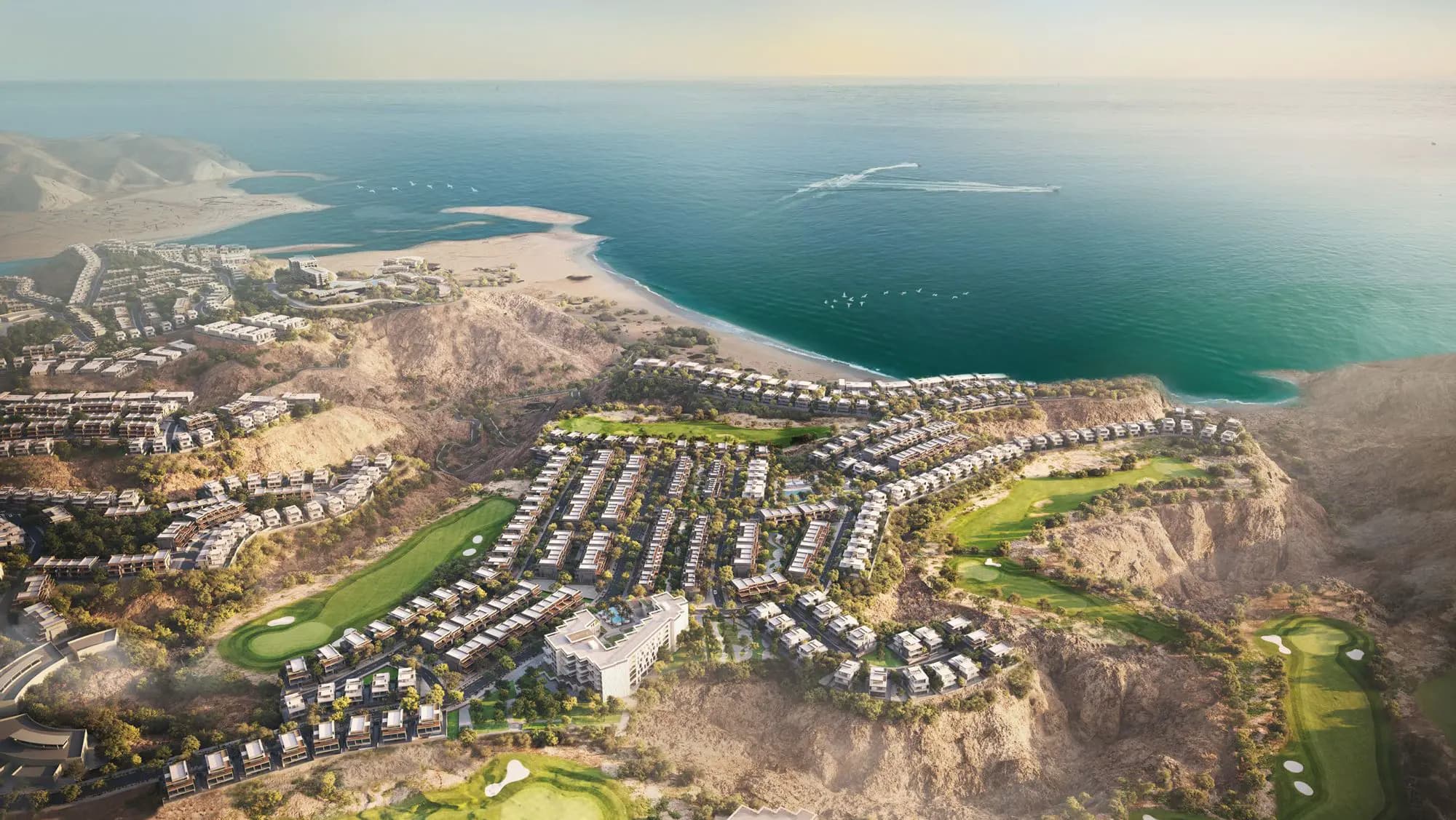 AvailableYiti, MuscatAIDA, OmanStarting from£200,000TypeResidencesExplore residence